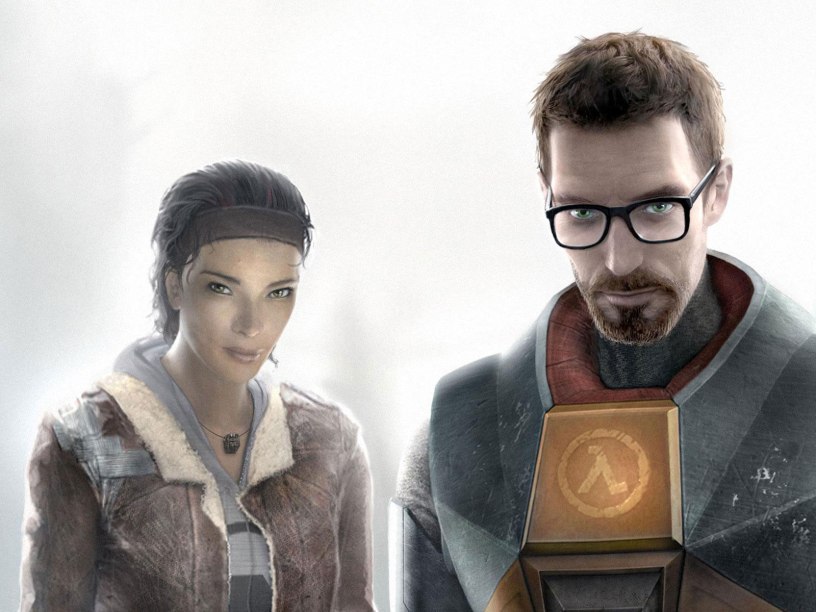
The dystopian, Big Brother feel runs all throughout Half-Life 2. You’re being watched, you’re being pursued, you’re being sought by the authorities for being a dissident. These are all themes I saw wound seamlessly into Valve’s FPS classic as I replayed it for the first time in over ten years.
Half-Life 2’s story-telling mechanics are seamless. With its understated presentation, there are no cutscenes (except in the intro before you start playing), and there is no lore to read. Valve communicates everything about the story directly through gameplay, NPC conversations, and environmental cues. You may not catch everything being communicated, as some of it is subtle, and you have the choice to not watch, listen, or pay attention, but it’s all there if you want it. It’s an incredibly refreshing method of storytelling in a video game, even if you’re someone who enjoys cut-scenes and appreciates deep lore in their games.
By nature, first-person games can be incredibly immersive – arguably more so than any other genre. You are literally seeing through the eyes of the main character. Because of that, the potential in a first-person game to convey emotions like loneliness, isolation, and fear are greater. Half-Life 2 seems to have an understanding of this that many of today’s first-person games do not.

While playing Half-Life 2, you won’t have someone constantly yammering at you in an earpiece, telling you where to go and what to do (because you as the “hero” of the story always need someone holding your hand, telling you how to be a hero, or you may get frustrated and stop playing). This is thankfully absent in Half-Life 2, as it was in the original Half-Life, and its expansions. You’ll often have to think on your feet with no help, as it’s you against the environment and the dangers that surround City 17. But there’s always a way through, no matter what seemingly insurmountable obstacles are thrown in your way.
Half-Life 2 is more of a thinking gamer’s shooter. While the game has plenty of brawn, it has puzzle solving sections as well, and they aren’t always easy. Granted, not like you would see in a Zelda or Metroid Prime game, but you do have to think your way through situations that don’t require using your weapons. Again, not something you see a lot of in today’s FPS games.
Replay value might be the only area where Half-Life 2 doesn’t completely excel. While it is primarily a single-player experience, Half-Life 2 is so well-crafted that you’ll likely want to play it more than once. That being said, any subsequent playthroughs won’t alter the experience much from previous playthroughs, as it is a memorable, albeit mostly linear experience.
However, its linearity presents itself in a way that makes you feel that you have more freedom than you actually do. You’ll spend a lot of time in open spaces for you to run around, explore, take out enemies, and solve puzzles in, but all of those spaces have only one way to progress. If the game wasn’t as expertly paced as it is, this might be a problem – but it never lets itself become derivative.
One of the more unique things about Half-Life 2 is its sound design. Valve does a masterful job of drawing you into their world using sound, and it does so mostly without using music. While it does have music peppered throughout the game, it’s only ever sporadic. There’s occasionally music driving you on, but the game mostly uses sounds from the enemies and the environment as its score, especially during the quiet moments. And it’s done well – so well that it draws you in as well as any game score. Half-Life 2 is proof that sound design is important, and you don’t necessarily need amazing music for great immersion in a game.

Maybe the most surprising thing about Half-Life 2 is how well it continues to hold up graphically. For a game that came out in 2004, its visuals have aged incredibly well. I had it running in 4K and 60 FPS, and I still found myself looking around admiring how good everything looks.
The water and overall texture work still look great. Character models and facial animations on the NPCs aren’t as sophisticated as what we see in today’s newer games, but they hold up well and don’t look bad or awkward. It does look like an older game, but there’s nothing in the game that ever made me wince. I often found myself admiring the scenery. Running at high resolution, everything looks especially sharp.
VERDICT:
Half-Life 2 is still a brilliant piece of interactive software after almost a decade and a half of its release. Its pacing, presentation, and gameplay are practically flawless in a world that is familiar, yet very alien at the same time. Running on a newer system, it still looks, sounds, and plays superb.
If you have any interest in FPS games at all, and if for some reason you haven’t played Half-Life 2 and its expansions (or the original Half-Life for that matter), you should feel strongly encouraged to make it a priority in your gaming backlog.
It’s a shame Valve doesn’t seem interested in making Half-Life games anymore. In this Call of Duty FPS era we’re currently in, Half-Life 3 wouldn’t need to reinvent the wheel the way the original Half-Life did. It would only need to remind us what the wheel used to be like.
 The Gamer's Standard