
When famed RPG developer Bioware announced they were developing a Star Wars role-playing game for Xbox and PC, Bioware and Star Wars fans rejoiced. At the time, the RPG genre was unexplored territory for Star Wars in the video game world, and in the early 2000s, this was Bioware at the top of their game.
Before Electronic Arts bought them. Before the dark times.
The original Star Wars: Knights of the Old Republic released in 2003, enjoyed critical success, and was embraced by fans as one of the best Star Wars games ever. A sequel quickly followed. Star Wars Knights of the Old Republic II: The Sith Lords released in 2004 for Xbox and in 2005 for PC. The only caveat was that KOTOR II was not developed by Bioware, but by newly formed Obsidian Entertainment.
The KOTOR games take place four thousand years before the Star Wars films. In KOTOR II, you’re an exile from the Jedi Order, and you have a price on your head so large that every bounty hunter in the galaxy is looking for you. You also have a powerful Sith Lord trying to hunt you down. Your quest is to figure out why all this is happening to you, and what affect it will have on all life in the galaxy.
After the Mandalorian Wars, the Republic is teetering on the brink of collapse. It’s up to you to either help stabilize the Republic, or use their problems for your own ends. What’s left of the Jedi are scattered, and there are Jedi Masters on various worlds you can help. Ironically, each of these Masters voted to have you thrown out of the Jedi Order after the Mandalorian Wars. Why exactly they did that is vague, but becomes clearer as you progress in your quest. As does why certain factions seem to want you dead after returning from your exile.
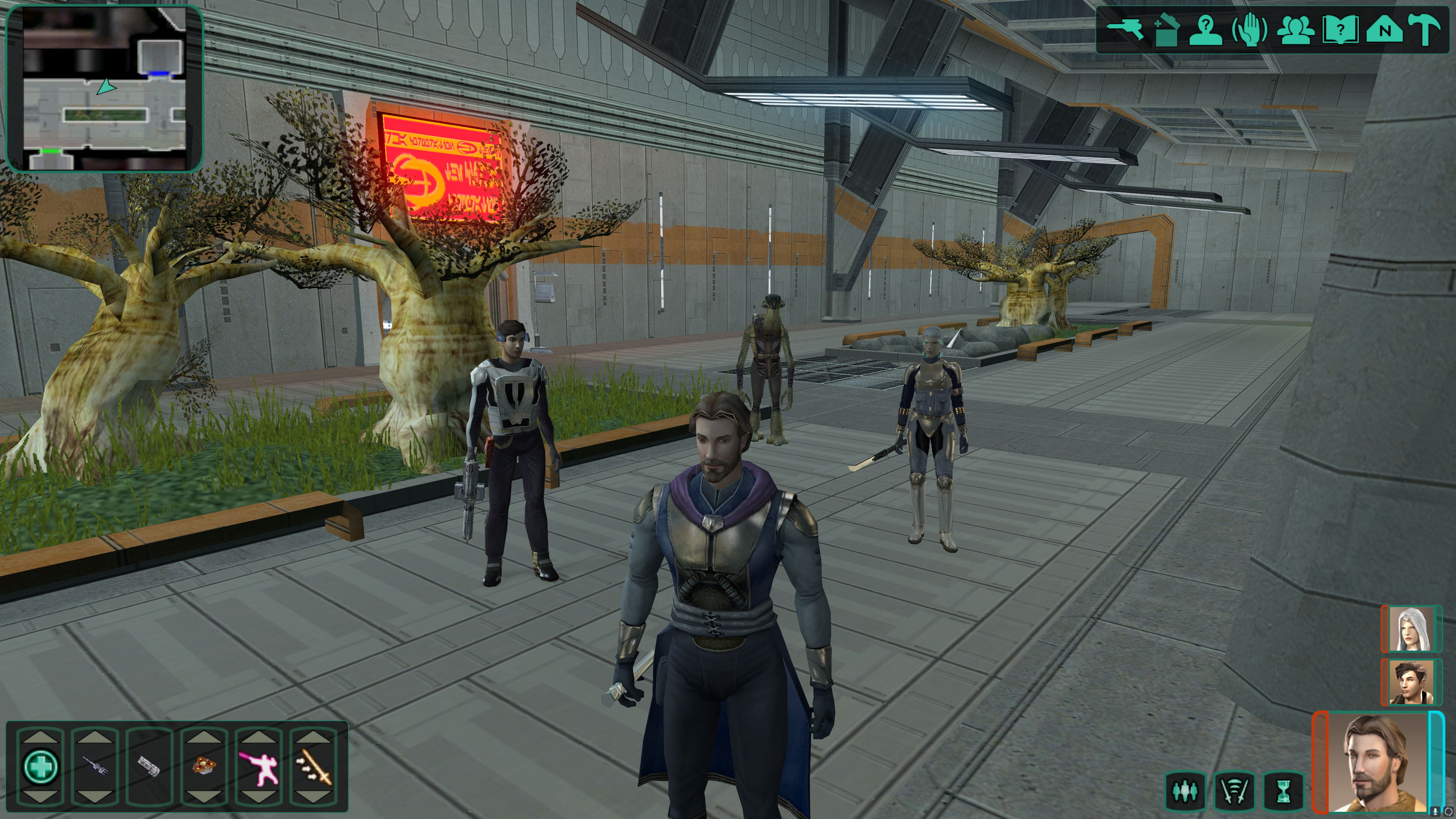
KOTOR II’s story is a slow burn. It doesn’t go anywhere for the first 10-12 hours, but it slowly starts to gain momentum as you put more time into it, and it eventually turns into something worthy of the Star Wars name. There is a lot of dialogue, but much of it is optional, since all the dialogue is delivered via the dialogue tree that Bioware uses in their RPGs. So if you want the full story, and are interested in all of the characters and side-quests the game has to offer, be prepared for lots of voice-acting and text. KOTOR II is a verbose game.
However, the voice-acting excels throughout. Your character isn’t voice-acted, but everyone around you has a lot to say. Subtitles are used in addition to voice, and can be turned on or off in the options. Aliens speak in their own language, with subtitles.
At times, I found myself having to read the subtitles quickly when an alien was talking, as the subtitle would change too quickly to the next line of dialogue. Thankfully, a log is kept of all recent dialogue, so you can easily re-read anything you may have missed.
The gameplay starts off very linear, and there isn’t a lot of exploration. It does a good job of easing you into the different game mechanics, especially the combat system, which is great for those that didn’t play the first KOTOR and need to be acquainted with the basics. For those that did, the first few hours are less than thrilling – but the more time you put into KOTOR II, the better it gets.
You start on a mining facility and everything looks similar. You go from room to hallway to room to hallway. Then to a bigger room. Some doors will open, some will be locked. You’ll find plasteel cylinders with different items you can use. There are workbenches that you can use to upgrade your weapon and any armor you’ve found. You’ll find a few consoles you can access, and sometimes hack, to open doors and progress in the game. Your ability to do that will depend on your computer and security skills, which you can improve when you level-up.
Eventually, you finally get to leave the mining facility, and escape onto a ship. However, the gameplay and linearity doesn’t change, and the ship doesn’t look that different from the mining facility. Eventually, you go back onto the mining facility, fight lots more droids, and then finally, make your way off the mining facility. Again, all this takes longer than it should. It feels like a ten-hour tutorial, but it does get you familiar with the mechanics of the game, while not taxing or overwhelming the player with difficulty early on.
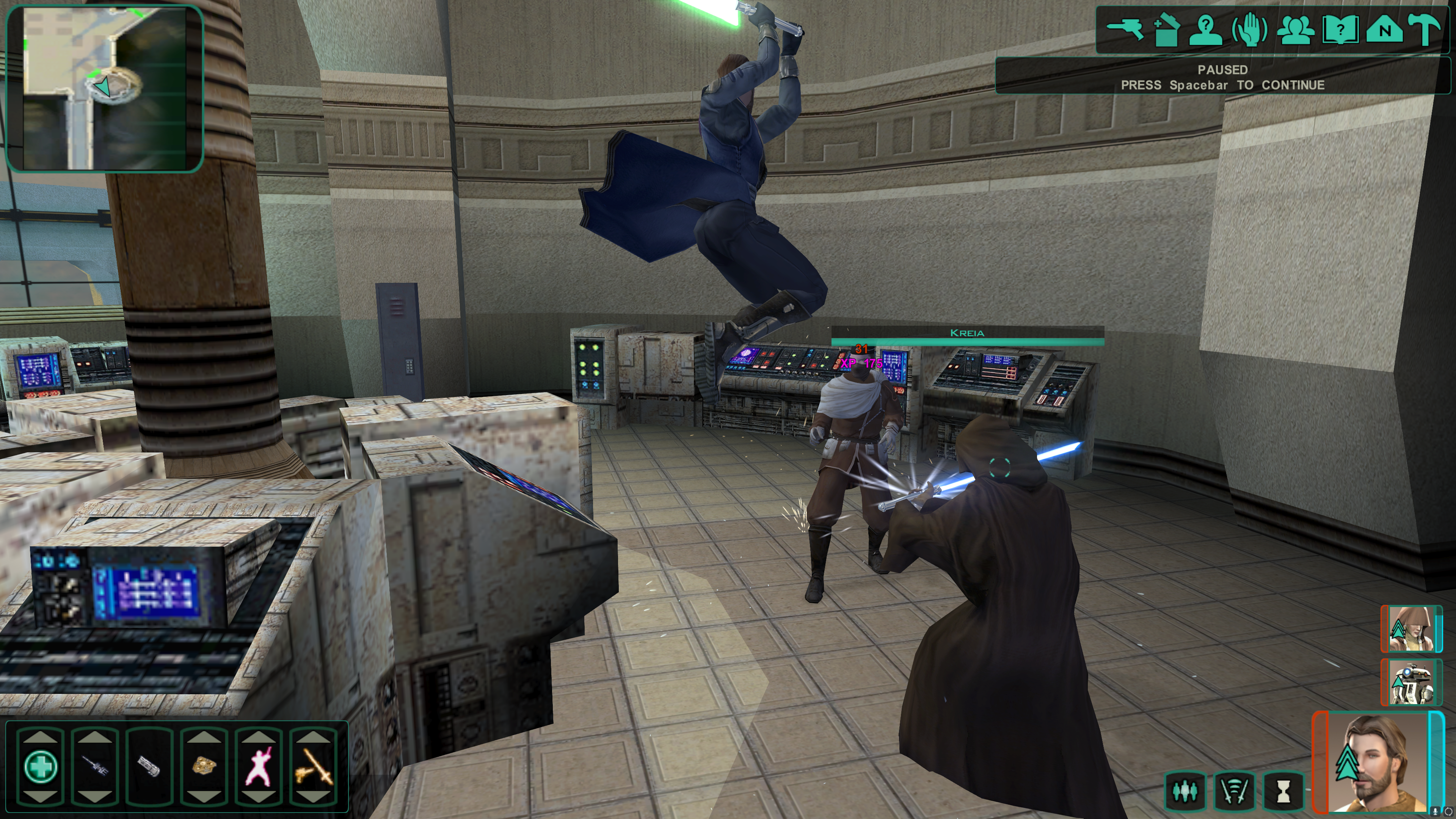
During this time, all your enemies are droids of various kinds. You’re not fighting any flesh and blood enemies – yet. And like the first KOTOR, while you are a Jedi (albeit an exiled one), you don’t have a lightsaber – yet. Until then, you use different swords and vibroblades as weapons. You learn the basic battle mechanics during this introductory part of the game, and then learn more of the nuances as you progress.
After the mining colony comes a space station. This is the first area in the game that allows you to do a significant amount of exploration. It’s the first “main” area of the game. You get lots of optional quests, and the story starts to come together.
Getting onto an actual planet in KOTOR II takes time. You spend the first 15-20 hours on either a mining colony, inside an asteroid, a ship, or a space station. However, when you do get onto the space station, the game starts to open up significantly.
There are a couple side-games you can play if you need a diversion from your questing. Swoop racing is a lot like podracing. The difference is there aren’t any turns. It’s a straight track. However, there are still hazards to watch out for that can slow you down. When your speed meter gets into the red, you want to shift to continue to increase your speed.
Playing on the PC version, that just meant clicking my left mouse button. Your racer then shifts into the next gear. You repeat that process while hitting boosts and avoiding hazards using the A and D keys on your keyboard. The races are short and not overly difficult with some practice.
You can also play a card game called pazaak for credits as well. Pazaak is basically blackjack. The differences are that you’re playing for 20 instead of 21, and you can pick a side deck. You play a best-of-five match. The first to win three rounds wins the match. You can also buy cards from certain dealers to enhance your pazaak game. If you get good at it, it’s a nice way to make some extra credits if you’re running low on funds. It’s also a good way to lose a bunch of credits if you’re not careful.
As with the original KOTOR, KOTOR II starts to really shine when you get your lightsaber. It’s at this point you really start to feel like a Jedi or Sith. Activating your custom-made lightsaber and watching your character wave and spin it around, taking out enemies and gaining XP, never gets old. During battle, you can pause the game and assign battle commands to the different characters in your party. Or just better position them correctly so they don’t die.
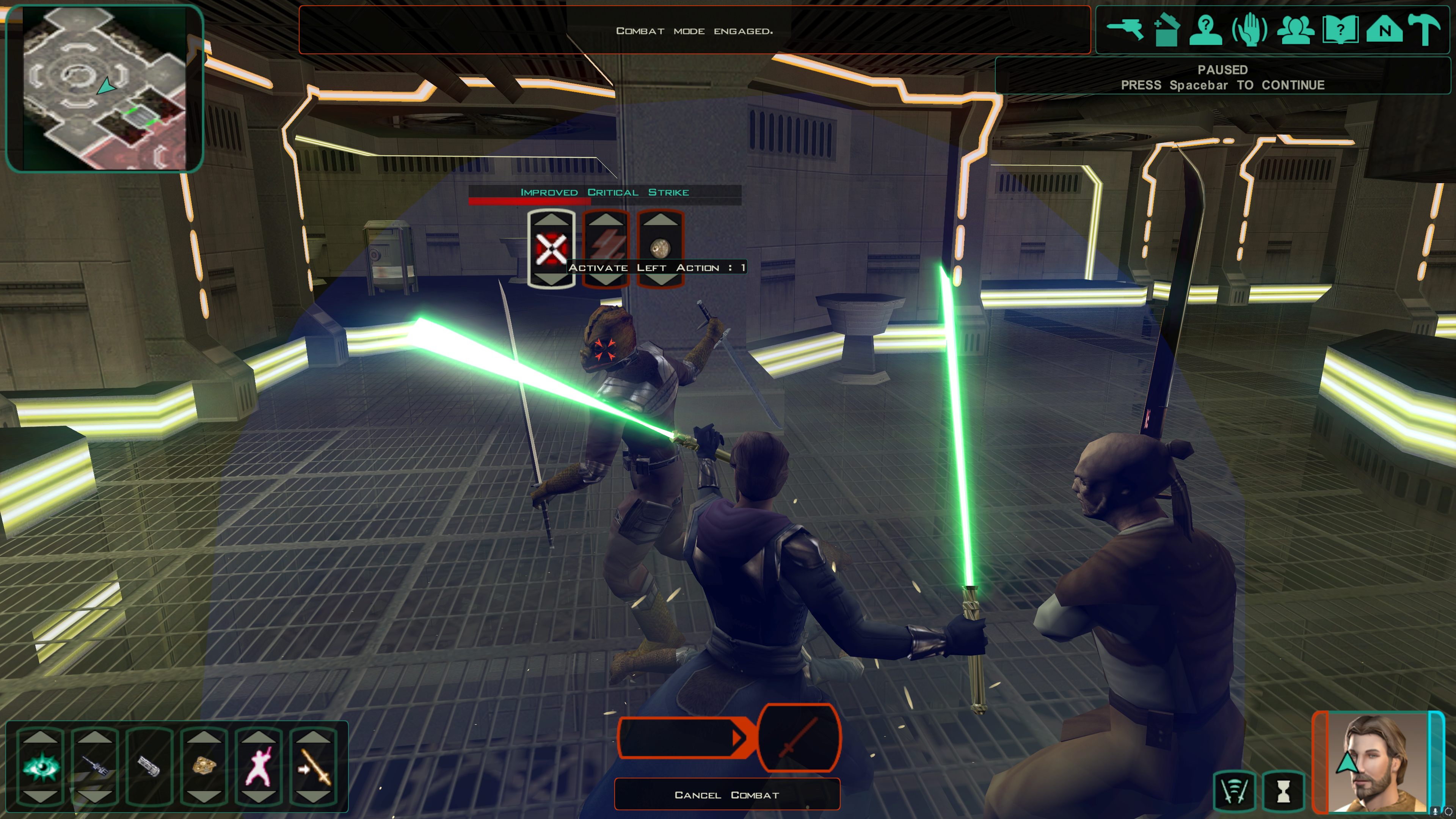
Fighting with any kind of melee weapon allows you a normal attack, a flurry attack, a critical strike, and a power attack. You can assign these in any combo you want, up to four at a time. Or you can combine your melee attacks with Force attack powers, or Force support powers, that heal and provide protection for you and your party. Then unpause the game and watch your characters masterfully vanquish your foes. Each attack has its own battle animation that is appropriate to its corresponding command. Fighting with ranged weapons give you a normal attack, a power blast, a rapid shot, and a sniper shot.
The only issue with the combat is the game’s bad habit of targeting a character in a group of enemies that is furthest away from my character. Instead of fighting the enemies right in front of him, he would try and run around them to get to an enemy in the corner of a room who’s just standing there. While my character is trying to do that, he’s taking damage from the other enemies. This cost me several deaths until I started looking out for it. This doesn’t happen during most battles, but it happened often enough to be an irritant.
Also, there is no grinding in KOTOR II. But unlike the first KOTOR, the level cap is raised significantly. The original KOTOR capped you at level 20. If there is a level cap in KOTOR II, I never hit it.
The ability to play through the game as either Jedi or Sith opens up KOTOR II to great replay value. While the basic story remains the same, how you react to the story, and the choices you make, give KOTOR II reason for multiple playthroughs. You can play as either Jedi or Sith depending on the choices you make. You can also choose between playing as a Jedi Guardian, Jedi Sentinel, or Jedi Consular. Each has different strengths. Guardians are stronger in combat. Consulars are stronger in Force abilities. Sentinels have a balance of both. Once you progress to a certain point in the game, you will have the option to choose a Prestige class. These are similar to the Jedi classes you choose from at the beginning of the game. They are Jedi Weapon Master, Jedi Watchman, and Jedi Master.
You can choose any Prestige class you want regardless of what class you chose at the beginning of the game. For example, if you you chose to be a Consular at the beginning, you can choose to be a Jedi Weapon Master as a Prestige class. Or vice-versa. This opens KOTOR II up to even more replay value.
KOTOR and KOTOR II were developed for the original Xbox, and it shows. KOTOR II isn’t an ugly game, but it shows its age. The character models look pretty solid, especially the characters in your party. This is good since you spend a lot of time looking at those characters. Everywhere else you look, most of the textures and polygons look dated. The cutscenes look pixelated and something you might see in a mid/late ‘90s PC game. Running the game in 4k, the framerate jumped around depending on my environment. Rarely did my framerate maintain 60 FPS. I was also getting slight pop-in in some environments as well.

However, the Star Wars aesthetic is everywhere. While KOTOR II doesn’t wow visually anymore, it still does a great job of looking like a game set in the Star Wars galaxy.
The voice-acting is fantastic. There wasn’t one time I winced or was taken out of the moment any time a character was speaking. This is an impressive accomplishment given the large amount of voice that is in KOTOR II. Like I said before, the game has a ton of dialogue.
The music and sound are what you would expect from a Star Wars game. The sound design is excellent, and the music by composer Mark Griskey delivers a John Williams caliber performance.
VERDICT:
Star Wars Knights of the Old Republic II: The Sith Lords is as satisfying of an RPG as you’ll find. It’s as satisfying of a Star Wars game as you’ll find. If you love Star Wars, or love RPGs, and haven’t played it or its prequel, you’re doing yourself a disservice. Aside from some pacing issues and some enemy targeting issues, KOTOR II is still fantastic. Its gameplay is timeless and its story is rich. This is one that’s worth playing through whether you’re new or you’ve played it before.
If anyone tells you KOTOR II is not as good as the original, try it for yourself before writing it off. Because it’s not only as good, it may be better.
 The Gamer's Standard