
In the late ’90s, the Zelda series was more popular than ever. The Legend of Zelda: Ocarina of Time was showered with Game of the Year awards in 1998, and to this day, is considered one of the greatest games ever made. Somehow, Nintendo completed its sequel, The Legend of Zelda: Majora’s Mask, less than two years later for the aging Nintendo 64. Being able to release a game so different, and with such a complex and unique core game structure, so quickly, was impressive and unexpected. Nintendo released Majora’s Mask in North America on October 26, 2000, the exact day of the launch of Sony’s PlayStation 2 in North America. Coincidence? Of course not. The console wars back then were intense.
Like The Adventure of Link on the NES, Majora’s Mask on the Nintendo 64 was the oddball sequel no one saw coming. It took the Zelda formula and turned it on its head in a way that is hard to wrap your head around at first – but as you continue playing, the structure of the game opens up.
If you’ve played the Nintendo 64 version of Majora’s Mask, the first thing you’re going to notice is the significant visual facelift the 3DS version received. Majora’s Mask 3D doesn’t look like a Nintendo 64 game anymore. It looks like a GameCube game, or even a Wii game. The improved texture work and character models in particular really stand out.
The faces of the characters don’t look like polygons squished together anymore. Link’s model and face looks smooth and non-triangular. The artwork in the temples have been redone and look stunning. Even on the 3DS’s limited resolution screen, the visuals all throughout the game look sharp and colorful. The load times in Clock Town when you go from one part of the town to another are noticeably reduced as well.
On the Nintendo 64, Ocarina of Time and Majora’s Mask were two of the best-looking games on the system for their time. The same can now be said for their 3DS counterparts. Grezzo and Nintendo did a fantastic job with the visuals, and turned two graphically aging games into two of the best-looking games in the 3DS library. This is no straight port or up-res of the Nintendo 64 game. Majora’s Mask 3D is a true 3D remaster.
They also managed to make the moon look even more menacing in the 3DS version. On the Nintendo 64, the moon merely looks angry. In the 3DS version, it looks downright psychotic.
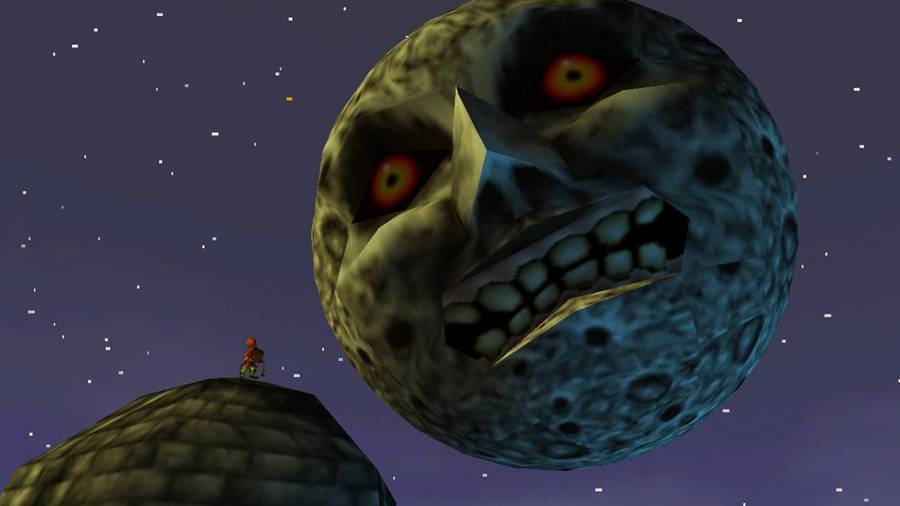
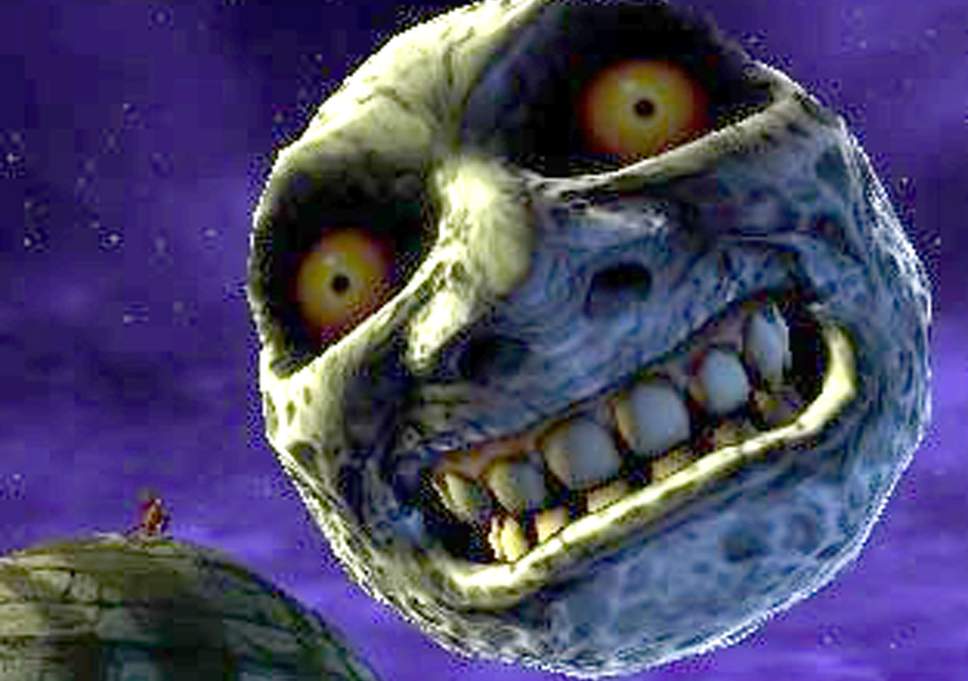
Majora’s Mask takes place over the course of three days in the land of Termina, in which Link is trying to prevent the end of the world as a giant moon slowly closes in, threatening to kill and consume everything. All of this is due to the Skull Kid and a mysterious talisman called Majora’s Mask.
Majora’s Mask has arguably the most compelling story of any Zelda game to date. You’re in a world that resembles Hyrule, but isn’t. All of Majora’s Mask, while still a hero’s quest, has a personal undercurrent to it that you don’t see in other Zelda games. While you are saving the land of Termina, you’re also affecting the individual lives of the people in Termina and Clock Town. You see how your actions affect the lives of the characters you meet. You see how they deal with the slow realization that their world and their lives could be ending. Some of them scoff at the idea, some are scared out of their minds, some are oblivious, and some are indifferent.
Majora’s Mask is as much about the sidequests as it is the main quest. It’s as much about the characters you meet as it is the dungeons. It’s as much about Clock Town and its people as it is the land of Termina. While it’s not necessary to beat the game, completing your Bombers’ Notebook and seeing the culmination of your efforts at the end of the game to help the people of Termina is immensely satisfying.
If you go into Majora’s Mask expecting a typical Zelda game with a long series of dungeons, followed by an epic battle with Ganon at the end, you’re going to be disappointed. Majora’s Mask is unlike any other Zelda game Nintendo has made. In fact, it’s unlike any other game, period.
Major touchstones from the Zelda series are absent. There is no Princess Zelda (aside from a brief cameo in a flashback at the beginning of the game). There is no Ganondorf. There is no Triforce. There is no Hyrule. Yet it’s still Zelda at its core. However, the darker tone, harder difficulty, and strange game design has been a turn-off for many gamers, and even some Zelda fans, since its original release.
The use and manipulation of time is the primary game mechanic. During the course of the three days, Link can use his ocarina to slow time down, move forward in time, or go back in time to the beginning of the three days. At the end of the three days, the moon crashes into Termina and everything dies. Game over. Your mission as Link is to prevent that from happening.
While the dungeons in Majora’s Mask are far from an afterthought, they’re not necessarily the highlight of the game either. In fact, they’re only about half the game, if not less, but they’re quite meaty and complex. Beating any of them in the course of the three days can be a challenge. The balance between dungeon-crawling versus exploration and doing sidequests in your Bombers’ Notebook is close to perfect.
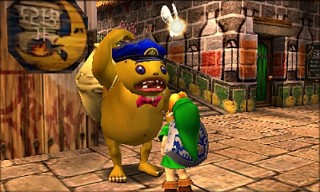
The other half of the game, if you choose to complete everything Majora’s Mask has to offer, is your Bombers’ Notebook.
The Bombers’ Notebook is basically a glorified quest log that keeps track of the different people and characters Link meets in the land of Termina, and gives him clues as to how he can help them. As he completes it, he’ll be rewarded with rupees, pieces of heart, different masks, and other major items. When he goes back in time to start the three-day cycle again, he’ll keep all those items, and any other major items he’s acquired. However, minor items like rupees, arrows, bombs, bugs, potions, water, etc. will be lost. However, he can deposit rupees at the local bank in Clock Town for use whenever he needs them.
The Bombers’ Notebook has been changed from the Nintendo 64 version to make it more usable. The 3DS version has a section called Rumored Events that gives you a healthy starting point, while in the Nintendo 64 version, you’re mostly left to figure it out on your own. For the overall game design, this was a good decision since the Bombers’ Notebook in the Nintendo 64 version has a definite learning curve – but for nostalgia and some extra challenge, it would’ve been nice to have the option to turn the Rumored Events off.
The save system is adjusted in the 3DS version as well. You can now permanently save your game at any of the save statues. In fact, they added more save statues for the 3DS version. Whereas, in the Nintendo 64 version, you could only permanently save your game when you used the Song of Time to go back to the beginning of the first day. I assume Nintendo did this to prevent players from abusing the save system and the time travel mechanic and possibly breaking the game.
While Ocarina of Time toyed with the idea of masks, they are the centerpiece of Majora’s Mask. The different masks Link acquires and uses are what allows him to progress through the game. Figuring out how and when to use them as he battles enemies, takes on complex dungeons, and helps the people of Termina, is key. Link gets them by doing tasks in his Bombers’ Notebook, which helps him complete other tasks in his Bombers’ Notebook, and the game’s main quest.
However, a few of the masks change Link into other creatures entirely. These creatures are familiar to Zelda fans and are essential to completing the game’s dungeons. You spend a significant amount of time playing as these creatures (no spoilers). They have their own unique abilities that he needs to progress in the game. While he doesn’t need to get every mask to beat the game’s main quest, the reward for doing so is definitely worth the effort.
As in Ocarina of Time, music and playing simple tunes is still a major component of Majora’s Mask, although the focus is more on using music to manipulate time and events. The songs Link plays can be used in combination with the masks he wears to solve puzzles and do tasks in his Bombers’ Notebook.
Controls and button layouts in Majora’s Mask 3D are similar to Ocarina of Time 3D. The game is played on the top screen, while all your items, masks, and maps are readily available and accessed on the bottom screen. It works mostly well, but with a few exceptions.
Why Nintendo chose to leave the d-pad unused is a mystery. In the Nintendo 64 version of Majora’s Mask, being able to look around in first-person view was a quick press of your C-up button. This could’ve been mapped to the d-pad for the 3DS version, since it’s lying conveniently right under where your left thumb already is on the analog pad. Instead, Nintendo chose to map first-person view to the touchscreen. You can use your thumb to touch the upper left-corner of the touchscreen to do so, but the d-pad seems like it would be more intuitive.

Nintendo also mapped some of the item functionality to the touchscreen as well. In addition to the X- and Y-buttons on the system, you can also assign two additional items to the I- and II- spaces on your touchscreen. Again, this might’ve been better assigned to the d-pad. There are essentially four buttons on the d-pad that are unused. At least having the option to remap your item function to your d-pad would’ve been a nice feature. The only thing the d-pad is used for is to hear Tatl’s messages when you lock onto an enemy.
Other than that, the game controls well, and is very similar to its Nintendo 64 counterpart. The motion-control aiming for your bow & arrow is especially helpful. You can use the the analog pad to aim, or move your 3DS system for more precision. I found that using the analog pad, and then using slight motion-control adjustments, hit the sweet spot for accuracy when using Link’s bow.
The biggest change that Majora’s Mask 3D brings is the addition of a fishing mini-game. Although it’s not that “mini” in Majora’s Mask.
Ocarina of Time had a great fishing mini-game, but the Nintendo 64 version of Majora’s Mask never had one. The 3DS version of Majora’s Mask brings the same fishing that Ocarina of Time has, but with a twist. Instead of just trying to catch the biggest fish, Link is trying to catch different kinds of fish. What kind of fish he’s able to catch can be determined by which of the three days he’s fishing on, what kind of mask he’s wearing while fishing, or playing a certain melody.
On paper, it sounds great. In execution, it falls flat.
First, Link can’t target the fish. In Ocarina of Time, Navi would hover over different fish in the water. This allowed him to target the fish the same way you target enemies in combat, and then cast his line in that fish’s vicinity. It worked great. In Majora’s Mask 3D, Tatl will hover over the fish, but using your target button does nothing.
Second, although the game gives clues via posters on the wall of the fishing hole about what masks will allow Link to catch which fish, the clues don’t always work. Apparently, it’s random whether the fish he’s trying to catch is actually available to catch. So although he may have the correct mask, the specific fish he’s trying to catch may not even be in the water.
If Link swims in the water with a certain mask on, you might hear the Zelda chime. Presumably, that means Link has attracted a certain type of fish with that mask. As a result, he might get some fish reacting and splashing around, sometimes right in front of him on the shore. It would be easy to just go and pick them up at that point if the game allowed you – but you can’t. Link has to catch them with the fishing rod..
Your only option at that point, since Link can’t target the fish that is literally right in front of him, is to cast his line in the vicinity of the fish, reel it in to where the fish is splashing around, and hope it bites. Many times, it doesn’t. It’s tedious and frustrating. The simple mechanic of letting him target the individual fish would’ve helped. Or just letting him drop his line in the water instead of casting it would’ve helped as well. Maybe Nintendo wanted to make the fishing more challenging than it was in Ocarina of Time. If so, this wasn’t how to go about it.
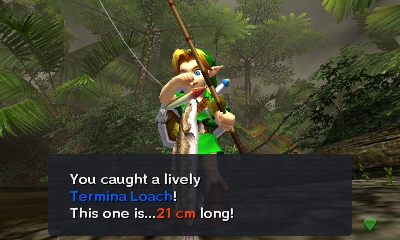
Even if you get all the fish in the game, there’s no reward. Although the game will keep track of which fish Link has caught, and how big they are, any fish he catches goes right back in the water. It’s a pointless addition to Majora’s Mask whose mechanics don’t work well.
Majora’s Mask didn’t need a fishing game. Yes, Ocarina of Time had one, and maybe Nintendo originally intended to have fishing in the Nintendo 64 Majora’s Mask – but it takes a superb game and doesn’t make it better. It’s another thing to do that, while optional for the player, ends up being more tedious than fun.
VERDICT:
The Legend of Zelda: Majora’s Mask is a dark and dense experience. The whole game is a giant adventure-puzzle. If you’re experienced with the Zelda series, beating just the main quest of Majora’s Mask will provide a healthy challenge. Completing the Bombers’ Notebook as well will probably have you scratching your head at times.
If you’re a first-timer to the Zelda series, go play Ocarina of Time or A Link to the Past first. Don’t start with Majora’s Mask. Come back to it when you have some experience with the basic mechanics of how the series works. The unique structure of the gameplay isn’t recommended to a Zelda newcomer. Being a direct sequel to Ocarina of Time, it’s geared more towards veterans of the series.
But if you’re a veteran of the series and want a strange and unique challenge that’s unlike anything Nintendo has done with Zelda before, Majora’s Mask is a dark gem. It’s the strange, somewhat misunderstood, but brilliant sibling to Ocarina of Time that a lot of people missed on the Nintendo 64 and GameCube re-release. Although the 3DS remaster is the definitive version of the game, there’s nothing wrong with the original.
Because when Majora’s Mask clicks and gets its claws into you, it really clicks. It’s a marvelous game that Nintendo should do a sequel to someday. A return to the land of Termina would be very welcome.
 The Gamer's Standard