
Metroid: Samus Returns is a beautiful 2D reimagining of Metroid II: Return of Samus for Game Boy. The game’s 3DS release rights two wrongs: it finally gives Metroid II the justice it deserves, and it serves as an apology to Metroid fans from Nintendo for neglecting the series for as long as they did.
Samus Returns fixes a mistake Nintendo made in 1991, which was putting Metroid II on the Game Boy, a system that didn’t have the horsepower to do the game design justice. The result was a solid, ambitious, but technically clunky game that would’ve done much better on the more powerful NES/Famicom hardware than the monochrome Game Boy.
Samus Returns is more of a reimagining of the original Metroid II than a blow-by-blow remake. The basic premise is to eradicate every Metroid from planet SR-388. As Samus explores deeper into the planet, she encounters Metroids of different types. Every encounter acts as a boss fight, and each section of the map has a set amount of Metroids that need to be put down. When she defeats one, she harvests its DNA and returns it to a giant altar that occupies each section of the game world. When all of the Metroids in that section have been defeated, a new area of the map opens up for her to progress. It’s simple and very similar to Metroid II on Game Boy.
When she get a major power-up, it changes how you play the game. Samus is stronger, faster, more powerful, more nimble, and has more freedom to explore the world. Aeion abilities are new to the Metroid series and are a great addition. They add to Samus’ arsenal and serve to make her feel even more powerful. The only difference between them and traditional power-ups is the ability to turn them on and off on the fly using the d-pad, but the function they serve is the same. Without spoiling what they do, just like normal power-ups, she needs them to progress.
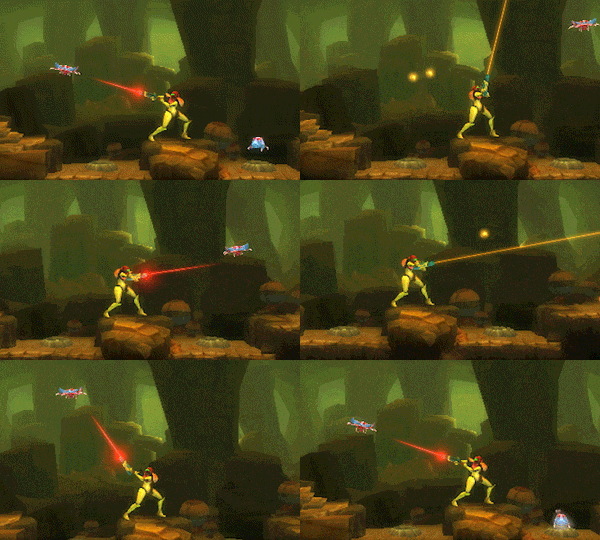
If you’ve been playing Metroid games for awhile, there are elements of Samus Returns that make you wonder why they weren’t in previous installments. For example, the 360-degree aiming with the analog pad works wonderfully – but then you remember the last 2D Metroid game came out in 2004 on the Game Boy Advance, and 360-degree aiming would have been impossible on the system’s d-pad.
The ability to counter is another new feature of Samus Returns. Many of the enemies will charge Samus on sight, but with a well-timed press of the X-button, she will swing and hit the enemy, stunning them and knocking them back. Then it’s a matter of finishing them off with a shot from her arm cannon. The game even auto-aims for you after a successful counter, making it a quick fight. This is a mechanic you will have to learn quickly, as many enemies, and even some Metroids, require you to execute it often.
In true Metroid fashion, there are lots of enemies native to the planet Samus is on. Some of them want to be left alone and won’t harm her unless she touches or threatens them. Others are more aggressive and will attack on sight. The game has a habit of relying on off-screen enemies to ambush her as well, which can get annoying. This is an old tactic that game designers have been using with 2D games since the ‘80s. It’s not any less irritating now than it was back then, and it happens a lot in Samus Returns.
The game is surprisingly large, but the end of the game seems a bit stretched out. In the beginning, Samus is encountering Metroids fairly often, while during the end, she goes long stretches without encountering any. This isn’t necessarily a bad thing if you like the exploration aspect of Metroid. However, if you like to speedrun your Metroid games and are gunning for the best ending, you might not like it.
Getting the best ending in 2D Metroid games is based on your completion time, as opposed to the 3D Metroid Prime games which are based on your completion percentage for power-up items. For those who have more of a completionist play style rather than a speedrunning play style, it would be nice if 2D Metroid games like Samus Returns also rewarded completion percentage for what kind of ending the player gets after beating the game. Appreciating the mood and the atmosphere of the alien worlds the Metroid games take place on is one of the defining aspects of the Metroid experience. It’s hard to do that when your focus is on speeding through the game. Unfortunately, if you’re the type of player that likes to stop and smell the roses a lot, you won’t get the best ending in Samus Returns, but it’s there for those that like to speedrun.
This is the first 2D Metroid game in 13 years and what is noticeable right away is the game’s look. Samus Returns is an artistically ambitious game for the 3DS, with 3D models used for Samus and all the creatures and enemies she encounters. Even though it’s not made by Retro Studios, Mercury Steam captures the artistic spirit and feel of the Metroid Prime games and translates it into 2D. It’s dark, exotic, lonely, claustrophobic, and sci-fi to its core.
Excellent use is made of the 3DS’s 3D ability as well, as the game has lots to look at in the backgrounds. The art and animations look fantastic, and is some of the best you’ll find on the system. The strange and exotic creatures that inhabit planet SR-388 animate in the distance and add to its alien feel. It makes you want to explore and see what’s going on back there.

Overall, Samus Returns is one of the most graphically impressive games on the 3DS, but like Resident Evil: Revelations, it feels like it was made with a more powerful system in mind as well. It wouldn’t be surprising if Nintendo eventually ports Samus Returns to the Switch. It already looks great on the 3DS, but it could drop jaws on more powerful hardware. With the strong art direction already in place, it could be one of the best-looking games on the Switch. The only trade-offs would be no 3D effect or second screen, but I think Metroid fans would be okay with that.
Samus Returns’ music continues the tradition of great Metroid soundtracks. It’s a great combination of new tracks and classics that soothes the ear and immerses you. Dark, exotic, and ambient would be good descriptors of how Metroid has always sounded, and Samus Returns is no different. Kenji Yamamoto once again directs the soundtrack, and once again delivers.
The game does have a story, albeit a small one, but there isn’t one piece of dialog spoken anywhere throughout the game. Samus never says a word. Critics of Other M and Metroid Fusion will undoubtedly find this refreshing, as both of them harshly panned for too much talking and story.
Now we come to the unpleasant part of the review.
In the past, Nintendo didn’t think twice about including unlockable art and unlockable difficulty modes as part of the package for any of their games. It was included as part of the asking price, Metroid games included. However, with Samus Returns, Nintendo saw fit to gate the Fusion Mode difficulty (the hardest difficulty), and unlockable art, behind amiibo – which essentially make them paid DLC. Except it’s not really DLC, in the true sense, since there’s nothing to download, and the art and the extra difficulty mode are included in the software when you buy it – but you have to own a Metroid amiibo to unlock it and have access to it.
How infuriating.
This is not how you do extra content for your games, especially since the content was finished, included in the main game, and could easily have been accessible for everyone who bought and cleared the game, just like Nintendo has done in past Metroid games. Instead, they gated and locked it behind amiibo, just because.
The $40 asking price for the game wasn’t good enough apparently. Nintendo needed players to shell out another $15 for a Samus amiibo to have access to everything. This is a blemish on an otherwise great game and could’ve easily been avoided.
Fifteen years ago, unlockable artwork and difficulty modes were available to any player who beat the Metroid games Nintendo was putting out – but it’s 2019 now, and it’s trendy for publishers to nickel and dime their players for every penny they can squeeze out of them.
Nintendo has been hit or miss with their DLC strategies since they started experimenting with it on Wii U and 3DS. With games like Mario Kart 8 and Animal Crossing, it’s been a hit. With games like Metroid: Samus Returns, it’s a big miss and sets a bad precedent.
This wouldn’t be an issue if there was another way to unlock Fusion Mode and the artwork through playing the game, and the amiibo unlock was for players who wanted to save time and have it unlocked from the beginning – but that’s not the case here. You can only unlock the content through a Metroid amiibo.

Turning extra difficulty modes and artwork into micro-transactions is exploitation, and is not acceptable. Not all players have the desire, or the financial ability, to buy dozens of amiibo for Nintendo’s various amiibo DLC they’ve been pushing in their games. Punishing those players by locking content behind them that they used to get as part of the asking price for a game isn’t consumer-friendly by any standard.
VERDICT:
So after years of pleading with Nintendo and throwing internet temper tantrums, Metroid fans finally got their remake of Metroid II. Was it worth the wait? Yes. Will we have to go another 13 years before we get another 2D Metroid game? We better not. Metroid Prime 4 is still a ways off, but at least we know it’s coming and actively being worked on. The heavy rumors of Metroid Prime Trilogy for the Switch would help smooth things over even more in the meantime.
When Nintendo makes up their mind and does get around to making a true-to-form Metroid game, they deliver. As a fan, it’s frustrating having to wait so long between installments, but when it does happen, it’s always memorable. Metroid: Samus Returns is no different. It’s a beautiful 2D reimagining of the Game Boy’s flawed gem and will go down as one of the 3DS’s best games. It’s the proper Metroid II remake/reimagining fans have been begging Nintendo for.
 The Gamer's Standard