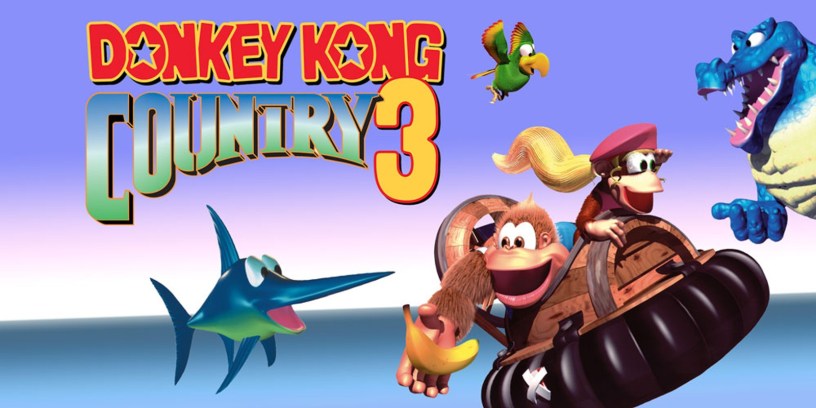
The original Donkey Kong Country is credited for saving the Super Nintendo Entertainment System from being upended by the Sega Genesis in the early 1990s. The game was a breakthrough in graphics and sound technology for console games, and was a giant seller for Nintendo. Maybe most importantly, it put British developer Rare on the map. Rare instantly became a darling for Nintendo fans and went on to become one of the most successful video game developers of the ’90s.
Donkey Kong Country 2: Diddy’s Kong Quest followed a year later. It’s everything the first game is, and regarded by many as the best entry in the Super Nintendo Donkey Kong Country trilogy.
Donkey Kong Country 3: Dixie Kong’s Double Trouble followed a year after that in November 1996. The exception being that this time, its release was dwarfed by the launch of the Nintendo 64 and Super Mario 64. As a result, Donkey Kong Country 3 flew under the radar for many compared to the first two games.
The Donkey Kong Country series has a history of being graphically impressive, but difficult 2D platformers, and tend to be divisive among some gamers. The difficulty has been a turn-off for some who criticize the games for being graphics over gameplay. They’re 2D platformers that, by today’s standards, might not be as impressive as they were in the mid-’90s when they first released.
The original Donkey Kong Country gets tons of praise for its breakthroughs in graphics and sound, but perhaps doesn’t get enough credit for the gameplay innovations it brought for its time. Being able to switch between two different characters on the fly, each with their own strengths and weaknesses, the use of animal buddies, blast barrels, mine karts, numerous bonus levels, the roll/jump mechanic that becomes essential to get some of those elusive KONG letters and hard to reach bananas, extensive swinging and climbing, and more, all serve to give Donkey Kong Country its own distinct flavor.
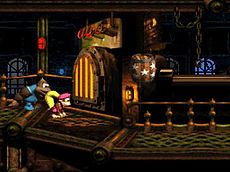
Donkey Kong Country 2 refines and expands on the original game by allowing you to use Diddy and Dixie Kong to pick up and throw each other to hard to reach locations. Dixie’s float mechanic also changes up the gameplay.
Donkey Kong Country 2 isn’t just a horizontal game like its prequel either. It’s also a vertical one. It introduces levels that run up-and-down, instead of the standard left-to-right that make up almost all the levels in the original game. It also brings gold coins and DK Coins into the gameplay recipe that you use as currency to save your game, play trivia mini-games, and access shortcuts.
However, the only real innovation that Donkey Kong Country 3 brings is its explorable overworld, where you can explore around in Funky Kong’s vehicles to look for secrets. While an appreciated feature, it doesn’t change the actual gameplay when you’re in a level.
Donkey Kong Country 3’s biggest flaw is its field of view. For whatever reason, Rare saw fit to shrink the player’s field of view on-screen. Dixie Kong, Kiddy Kong, and all the enemies are larger on the screen than in the first two games. This makes it harder to see off-screen enemies and other hazards, and makes the game more difficult as a result – artificially so.
With the player’s limited view, dying because of off-screen enemies you can’t see is a constant issue that plagues Donkey Kong Country 3 all throughout. It’s a baffling design decision by Rare, and seems like a way to artificially make the game harder instead of using pacing and level design to improve the game. It’s a recipe for tedium and frustration for the player, and makes the game feel more confining, and is one of the reasons it doesn’t achieve the excellence of its two prequels.
Other Super Nintendo platformers like Super Mario World have the ability to move the camera forward a few inches by hitting the R-shoulder button. This allows the player to see upcoming off-screen enemies and hazards. Donkey Kong Country 3 lacks this mechanic, which makes off-screen enemies much more of a hassle to deal with. This is old-school game design from back in a day when games were more difficult, but also when level design wasn’t where it is today. Games were harder in the ‘90s, but not always for the better.
Maybe the biggest disappointment of the Super Nintendo Country trilogy is that you only get to play as Donkey Kong in the first game. While having to rescue Donkey Kong in Donkey Kong Country 2 is a nice twist, and is forgivable since the game is so good, not bringing the iconic ape back for the third game was a strange decision by Rare.
For younger Super Smash Bros. fans who may not have been around in 1994 when Donkey Kong Country first released, it was the game Diddy Kong made his debut. Donkey Kong’s simian sidekick has been a staple in the family of Nintendo’s characters ever since, even getting his his own racing game on the Nintendo 64, which was also developed by Rare. However, he is conspicuously absent in Donkey Kong Country 3, as is Donkey Kong himself.
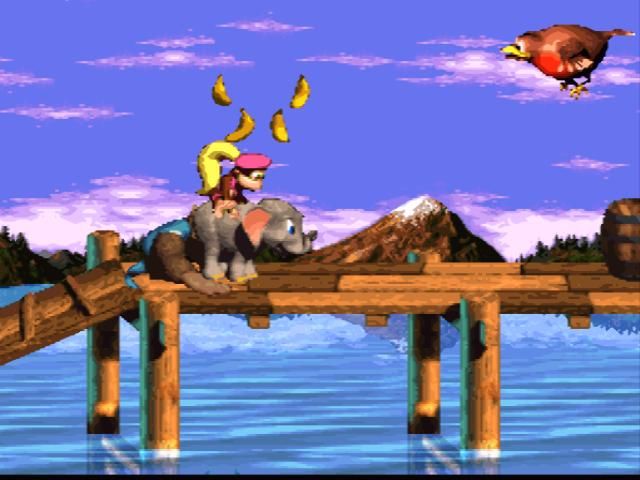
Dixie Kong was a well-received character in the second game, so bringing her back was the right decision for Donkey Kong Country 3. However, Kiddy Kong adds nothing to the game. He’s a big, strong ape that can take out larger enemies in the same way Donkey Kong can in the first game. Why Rare didn’t just use Donkey Kong instead for the third game in the series that bears his name is a head-scratcher. It wouldn’t automatically have made the game better, but it would’ve been nice to get to play as Donkey Kong again in his own series – and maybe the game would’ve done better under the massive shadow of Super Mario 64.
VERDICT:
Overall, Donkey Kong Country 3 plays like the leftovers from the first two games. It feels rushed, especially with its field of view issue, which handicaps it from the beginning. If you’re going to rank the five main games in the series, Donkey Kong Country 3 would probably be number five. While still a solid, playable, and fun 2D platformer, it doesn’t have the same punch as the first two games, mostly because it doesn’t bring much new to the table. It feels like Rare was out of ideas by the end. It plays like the B-sides from your favorite band. They’re still good songs, and if you put them together, they make a good album, but that album will never achieve the classic status that made you fall in love with the band in the first place.
However, despite its flaws, Donkey Kong Country 3 is still worth playing, and is one of the better platformers on the Super Nintendo. While not the game you want to start with if you’re new to series, it’s still a fun time and an interesting part of Donkey Kong Country’s history.
 The Gamer's Standard