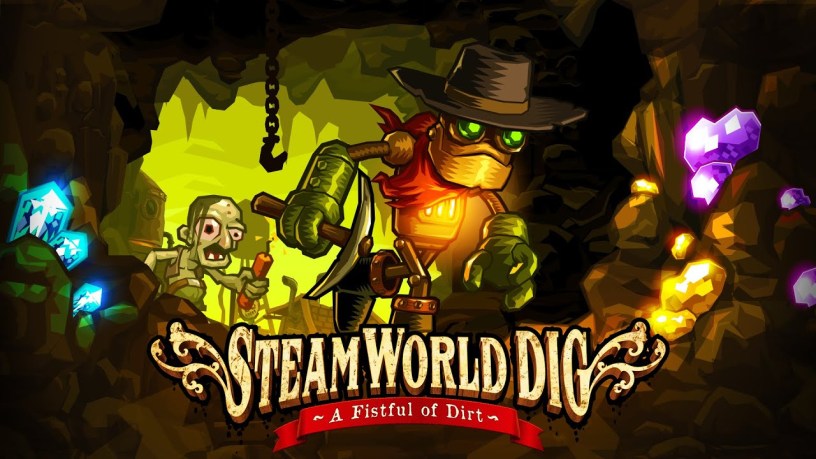
SteamWorld Dig takes place in a western frontier small town populated by robots that run on steam. Your character, Rusty, has taken it upon himself to explore the vast mines underneath the town to discover the mysteries that lurk beneath, and to find out what happened to his uncle Joe, who was also a miner and has gone missing.
The game is primarily about digging and collecting ore, and you get power-ups similar to what you get in other 2D action-platformers like Metroid and Castlevania. Where SteamWorld Dig differs is that you can also buy power-ups from the ore you sell. You can buy upgrades to your life bar, your water bar, your light bar, and your purse for carrying ore.
Digging, platforming, and exploring is primarily what SteamWorld Dig is about. Although there is combat with enemies to take out, you use your mining tools to do so. While it doesn’t reinvent the wheel with its core gameplay, its aesthetic and art design really pop on the Switch’s portable screen. Image & Form’s fantastic art direction and unique sci-fi ‘steam’ aesthetic made it appealing enough that it helped push me through the game’s shortcomings, which made me want to tear my hair out at times.
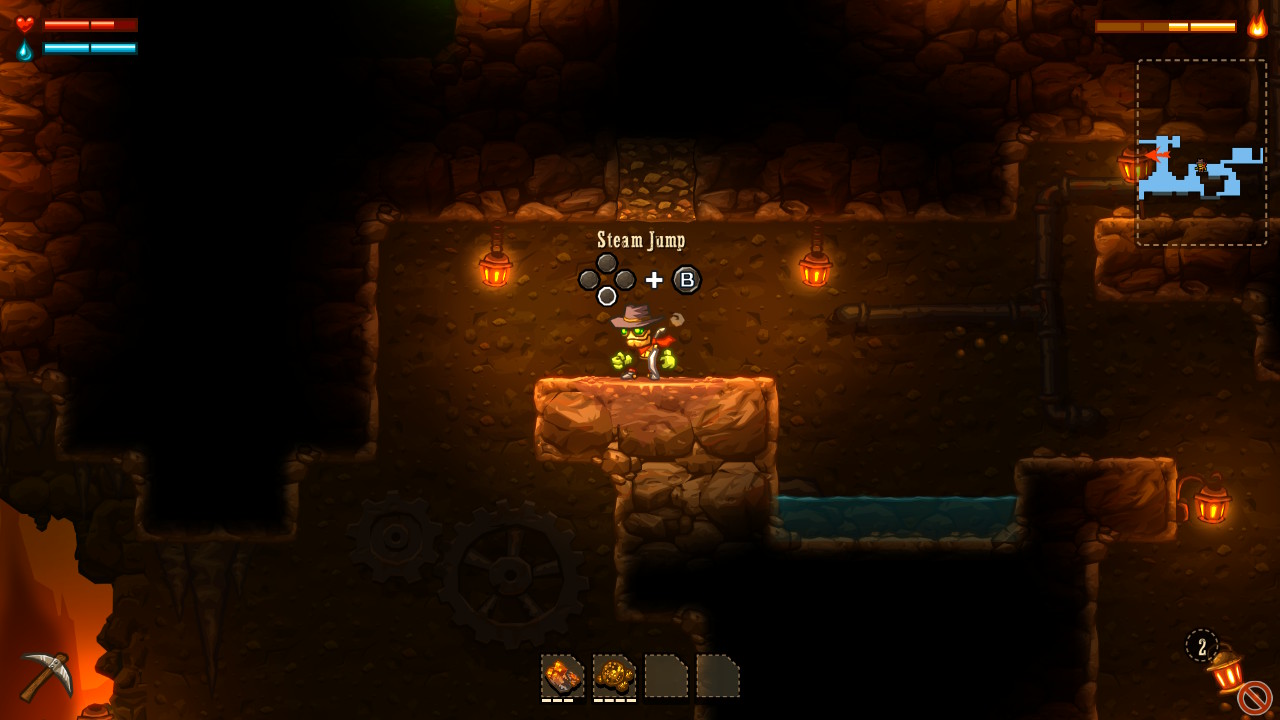
I first tried SteamWorld Dig on 3DS, and it didn’t resonate with me. My primary issue was that Image & Form made a game that revolves around digging and exploration, but then knee-capped that exploration with a constantly deteriorating light meter. Then if you die from not being able to see, the game heavily penalizes you by taking half your money and all your ore you’re carrying. As the difficulty increases, it becomes as much about managing your light meter as it does digging and exploring. SteamWorld Dig could be called Light Management Simulator because that’s what you’re constantly having to deal with.
I also didn’t like the slippery jumping mechanics and having to go back up to the surface all the time to sell ore because my purse was too small. Even the digging itself felt like a tedious chore having to bang on the same rock several times to get it to break.
So I gave up on it, but trying it again on Switch months later, it clicked when I played it not just as an action-platformer, but also as a survival game where you have to manage your life meter, your water meter, and most importantly, your light meter. I also found it helpful to go back to previous areas and grind for ore, since a good amount of the ore you come across early in the game can’t be dug up until you get more abilities – especially the orbs, which are hard to come by.
VERDICT
Approaching it as much as a survival game as an exploration and digging game made the difference. While it took some patience to figure out how to deal with its mechanics, I ended up really appreciating it by the end. If you can catch it on an eShop sale, you can get it for $2.50. It’s not a long game – you can beat it in under ten hours if you hurry – but it’s worth it.
 The Gamer's Standard