You can throw dozens, if not hundreds, of hours into roguelike games. Some of them have developed devoted followings who know every nuance and build the game offers. After spending time with three well-known games in the genre, Has-Been Heroes, Enter the Gungeon, and Dead Cells, I’ve realized what I don’t like about them: the RNG.
RNG stands for Random Number Generator. It’s a mechanic that allows the game you’re playing to randomly assign the value of an action, or it can determine what kind of weapons you get at the beginning of a game like Dead Cells. In short, you don’t get to choose what your toolset is at the beginning of a Dead Cells run, the game does.
I grew up playing difficult NES and SNES games, so the difficulty of these games isn’t an issue. Champions of the roguelike genre like to say that roguelikes are throwbacks to the retro days when games were difficult, and I agree with them to an extent. However, when I play Castlevania III: Dracula’s Curse on the NES, I always know what my toolset is going into the game. My primary weapon is always a whip or a mace, and my secondary weapons is either an axe, a throwing knife, holy water, or the ability to stop time for a few seconds, depending on my choice as the player. That means every time I play Castlevania III, I know what I have to work with.
That player choice is almost completely stripped out of the roguelike games I mentioned. When you “unlock” an item or weapon in a game like Dead Cells, that doesn’t mean you get access to it whenever you want (even though it should). It means that the game might let you use it during one of your runs if the RNG happens to land in your favor.
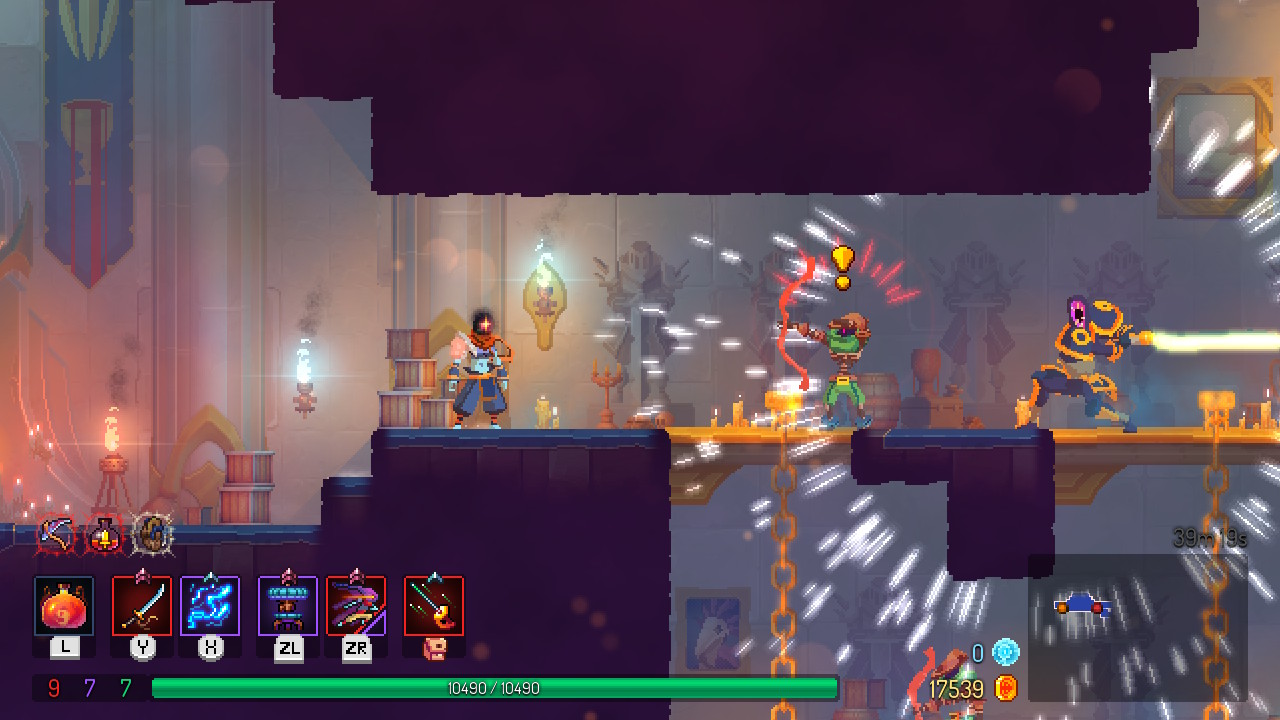
In fact, the RNG is so consequential in these games, it can almost single-handedly determine whether you’ll have a successful and satisfying run or not, all by itself. It’s a huge momentum-killer having a great run in Dead Cells or Enter the Gungeon, with a weapon combination you really like and that clicks with your playstyle, only to die, and get stuck on your next run with a weapon set that is nothing like what you were just playing with.
For example, I unlocked a certain sword in Dead Cells that I absolutely adored. The way it cleaved through enemies was perfection, and made me feel powerful as a player. Then I died, as one usually does when playing Dead Cells – and that was it, my sword was gone. My next run, I got a weapon that was completely different, and instead of playing to get better with my new weapon, my primary motivation for the next several runs was to try and find that sword again. It shouldn’t be like that.
The meta-game is very important for the player when they’re playing difficult games. Being able to strategize a difficult enemy or boss is essential. Even when you’re not playing, you might be thinking about the game and what you can do differently to get that edge and conquer it. However, you can’t do that if you have no clue what your weapon toolset is going to be the next time you fight that enemy or boss. As a player, you need to know what you have to work with, and Has-Been Heroes, Enter the Gungeon, and Dead Cells strip that out.
While I can do a few runs every once in awhile, I can’t throw myself into them the way I would like. My skill and the choices I make should be the ultimate deciding factor as to whether I succeed or fail in a run, and there’s too much that’s not in my control that determines my fate in those games that isn’t related to my skill as a gamer. If I’ve unlocked a skill or a weapon that I love, then give me access to it whenever I want. I don’t like having weapons I’ve unlocked rationed out to me as the game sees fit. If I’ve unlocked it, it’s mine. Give it to me and let me play.
 The Gamer's Standard