
Secret of Mana is a classic Super Nintendo game that I completely whiffed on. I remember seeing it in stores, but I didn’t hear much about it until years later when the retro-revival of the mid-2000s took place and people started playing NES and SNES games again.
In Japan, the Mana series is known as Seiken Densetsu (which translates to The Legend of the Sacred Sword). The first game was on the Game Boy Classic and was released in the west as Final Fantasy Adventure in 1991. The second game is Secret of Mana on Super Nintendo, which released in 1993, and the third game, which Square-Enix didn’t bring to the west until just recently, is called Trials of Mana. They all appear on the Collection of Mana compilation, which you can get on Nintendo Switch.
If Chrono Trigger and Zelda: A Link To The Past had a baby, it would be Secret of Mana. Even though Secret of Mana came out two years before Chrono Trigger was released, it feels like a halfway point between those two games. It’s a perfect melding of their sensibilities visually, and with its gameplay mechanics. Plus, it has a fantastic soundtrack.
Its real-time combat is a refreshing change from Square-Enix’s traditional turn-based battle system it had in almost all its other games from the ’90s. That means no random battles, and no mashing the attack-button in fight after fight as you mindlessly mow through enemies. You have to pay attention to the action on the screen at all times.
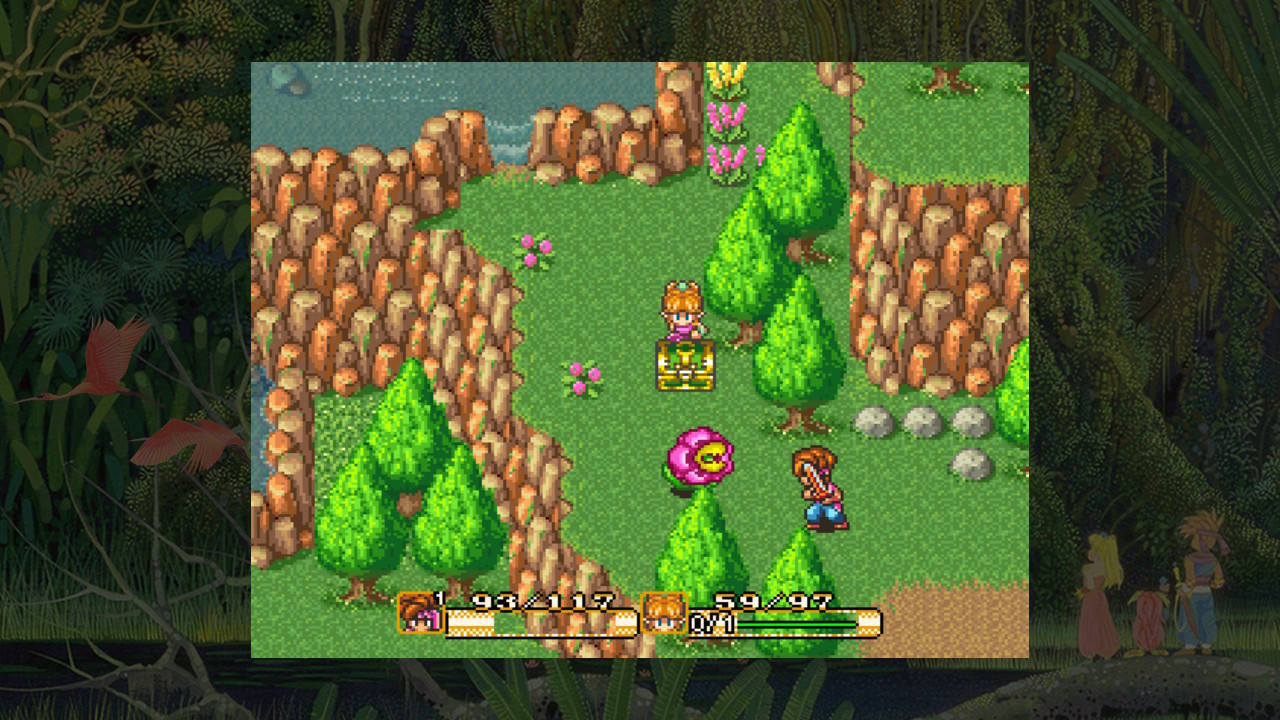
Your melee weapon has a recharge meter every time you attack. If you attack before the meter fills, your attack won’t be as strong. Since it takes a few seconds to recharge your weapon, it forces you to be mindful and strategic about how you attack. Then you can step back and let one of your other party members step in while your weapon charges. Or you can hold the attack button down and deliver a charged attack, which takes longer. You can switch between characters on the fly while you’re in combat and deck out all your party members with armor and accessories as you see fit.
It’s amazing how much more dynamic and engaging a good real-time battle system is in an RPG, as opposed to a turn-based battle system. Fans of turn-based battle systems will disagree, but I stand by it. It’s even better if you’re able to switch out weapons that change the way you fight, and be able to level-up your proficiency in each of those weapons as well. Throw some magic on top of all that, and that’s what Secret of Mana offers. Keep in mind that it came out in 1993, when games like this were not the norm, and turn-based RPGs were preferred by fans of the genre. Secret of Mana came out one year after Final Fantasy II (Final Fantasy IV), and two years before Final Fantasy III (Final Fantasy VI) were released. It makes grinding much more tolerable and, dare I say, fun.
There are three characters in your party, all of which can be leveled-up. All three characters also have weapon skills that can be leveled-up for each weapon. Two of the three characters have magic skills that can be leveled-up. Not to mention every weapon you get in the game can be improved with orbs.
However, for reasons I was never able to figure out, Secret of Mana doesn’t have any kind of map for most of the game, and it could definitely use one. Granted, there are plenty of handy signposts that do a good job of guiding you where you need to go, and you can get by. Even so, it’s strange playing an RPG without a good map, and it would’ve been a great quality-of-life feature to make the gameplay smoother.
In some sections, the game suffers from what a lot of games from its era suffered from: off-screen enemies. This was a notorious tactic used by game developers in the 2D era to make games harder. Secret of Mana is no different, even going so far as to hide enemies underneath big trees where they can’t been seen, where they attack you while they’re out of sight. Or they come out of hiding unexpectedly to tag you. Or sometimes they will position themselves on the screen where you can’t attack them. It’s just as annoying today as it was in the ’90s.
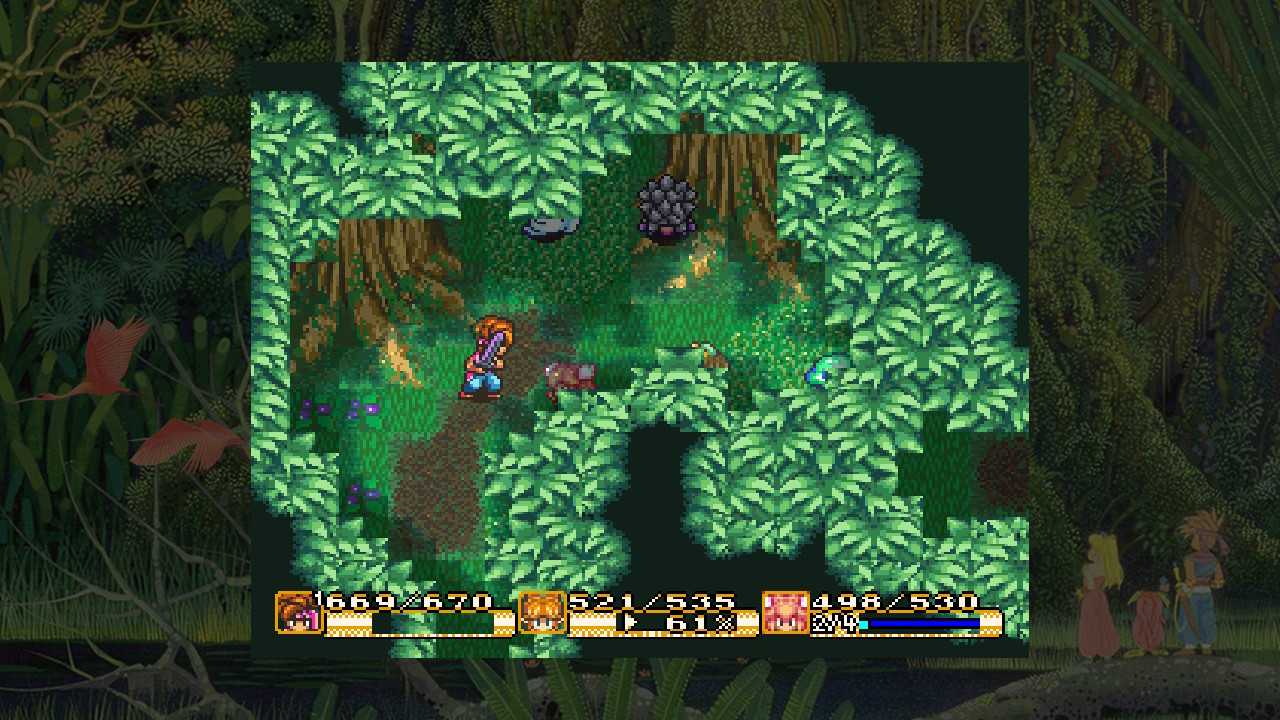
Enemies will respawn any time you go into another room, and sometimes they’ll respawn offscreen if you turn around and take a few steps in another direction. It’s works when you’re trying to grind for levels, but by the end of the game, it gets somewhat ridiculous. You can tell when the game is trying to be difficult by overwhelming you with enemies, but when you’re just trying to get your bearings and figure out where to go next (since the game has no map), it can become tedious and irritating. However, it’s somewhat redeemed because the battle system is solid and still holds up.
Also, the game seems to delight in being obtuse. For example, not telling you that axes can break certain barriers that allow you access to other areas of the game. There’s no way to know unless you discover it by accident – and it has to be the axe, not the sword, the whip, or the spear. If you don’t happen to have the axe equipped, you won’t know. The game has a ‘figure it out’ approach to almost everything. Thankfully, nothing in the game is so difficult that it will bring your progress to a standstill, but it will have you scratching your head at times.
The game has other idiosyncrasies that can get annoying. For example, if an enemy casts a spell on you, you can’t dodge it. As soon as the spell is cast, your character is frozen until the spell lands. However, that doesn’t apply when you cast a spell on an enemy, as they can still move around, and even attack you as you’re casting a spell on them.
Unlike Zelda dungeons, Secret of Mana’s dungeons have no puzzles to speak of. They’re basically comprised of kill-rooms, with different enemies in each room – or sometimes the same enemies. It can become a war of attrition since the only thing to do is fight. with you trying to get your party to your goal at the end of the dungeon
The game seems to enjoy placing your characters in close spaces where they can’t move around freely, and letting enemies tee-off on them. In fact, freedom of movement was a constant annoyance in the game. For example, flowers and weeds will hinder the movement of your characters. You have to chop them down with a sword or axe. I suppose you could argue that they’re actually really big flowers or weeds and that’s why they need to be chopped down, but it serves no purpose in the context of the gameplay other than to hinder your movement. In A Link To The Past, when Link chops down bushes and long grass, at least he gets rupees as a reward most of the time. When you chop down flowers and weeds in Secret of Mana, you get nothing, and you often have to change out your weapon to chop them down since they can only be cut using your sword or axe.
The story is light-hearted and doesn’t take itself too seriously at first. It had me chuckling pretty often with its humor and writing. Initially, it plays out more like an afterthought to the battle system, which is the core of the game, and will be what you spend most of your time doing. It has its serious moments as well and didn’t disappoint delivering a satisfying ending.
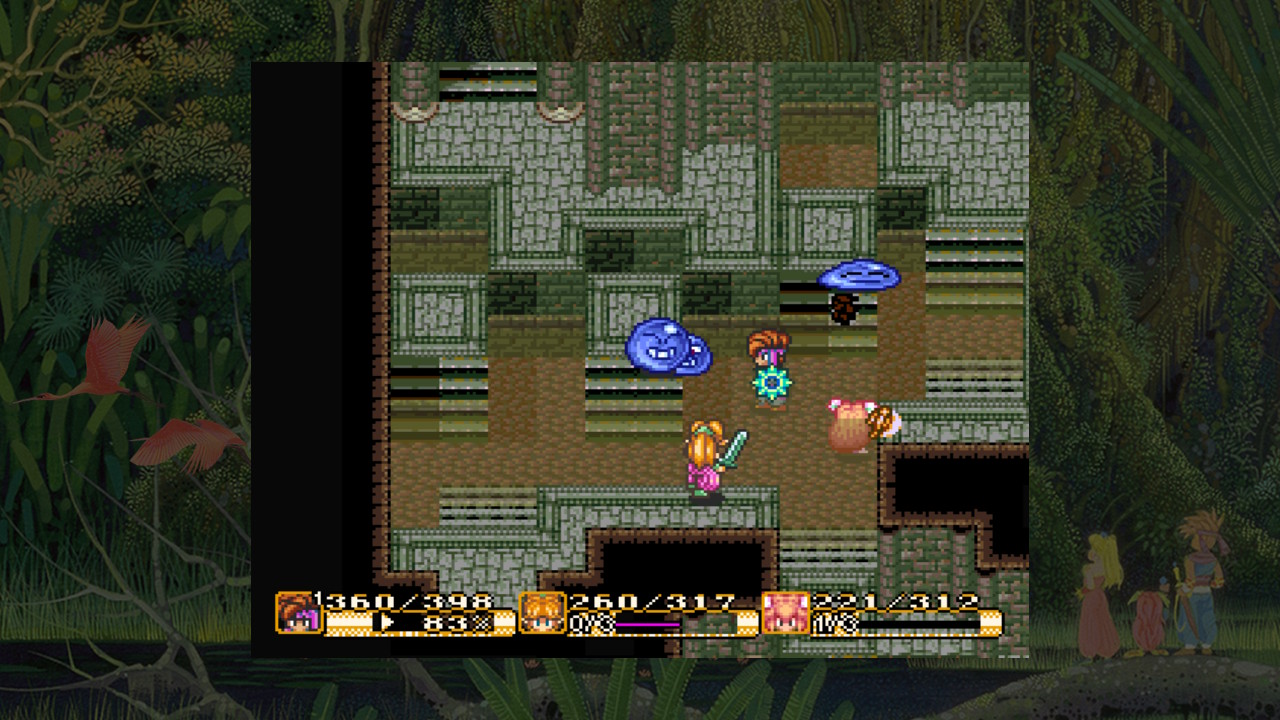
Visually, Secret of Mana looks like a Super Nintendo game. For a game that came out in 1993, it’s aged well enough, and resembles Chrono Trigger in its art style. The animations of your characters, the NPCs, and all the enemies still look great, especially in battle, and were ahead of their time in 1993.
Secret of Mana’s soundtrack was composed by Hiroki Kikuta, who has also worked on Romancing SaGa for Super Nintendo and Soul Calibur V. The music and overall sound design is strong. The tracks vary from driving to playful to ambient and serious. Secret of Mana would be a significantly lesser game if not for the music that constantly defines the world and the story. It’s one of the best Super Nintendo soundtracks I’ve heard, and one of the best aspects of the game.
VERDICT
Even though it could seriously use some quality-of-life improvements, Secret of Mana has withstood the test of time. The story starts off slow and silly, but by the end becomes quite serious and touching. The battle system is the heart and soul of the game, and is the primary reason to play it, and it’s accompanied by a kicking soundtrack that is one of the best the Super Nintendo offers. In fact, the battle system and the soundtrack are the two pillars that make Secret of Mana worth playing in spite of its retro-clunkiness. If you can get past how obtuse it can be at times, I heartily recommend Secret of Mana as a great action-RPG and as a great classic retro game. I’m excited to get into Trials of Mana to see what changes and improvements were made to the formula.
 The Gamer's Standard