
The immersive sim is a genre that doesn’t get talked about nearly as much as it should. Games like Thief, System Shock 2, Dishonored, and Deus Ex all share a lot of the same DNA: first-person games set in open, immersive worlds with great stories that emphasize player choice, and require thought and patience to play. Patience in the sense that they’re not fast-moving games, and if you try to breeze your way through them, you’ll experience a lot of difficulty unless you’re very good.
On the surface, Deus Ex looks like a first-person shooter: the game is in first-person and you can shoot enemies. Calling it a role-playing game would be more accurate. You’ll spend more time talking to NPCs, exploring, and being immersed in the story as you will shooting. You could run and gun your way through the game if you wanted, but you’d die a lot and be missing so much of what the game offers. This isn’t Half-Life, Call of Duty, or Bioshock.
Maybe the game’s biggest strength is the freedom of choice it gives the player. There’s never one way to do anything. If you find yourself stuck or having a difficult time trying to complete an objective, there’s almost always an easier and more creative way to go about it. There were so many times I completed a mission objective only to find out afterward I could’ve gone about it differently, whether it was sneaking into an area or room through an air duct instead of using lockpicks, or a more creative way to take out guards, or talking to a certain person for information that would’ve made progression easier, etc. There were many ‘Ahh’ moments when I discovered these alternate paths, and it immediately made me want to replay the game even before I had finished it.

Different player-builds provide a different experience. You finished the game as a handgun and rifle specialist? Now play through it again as a hacking and lockpicking specialist. You can play through the game ten times and use a different build on every run. Between where you spend your skill points and which of your augmentations you choose to upgrade, the freedom of choice for the player is very high.
Skill points act as experience points. You get them for exploration, for progression, for talking to NPCs, for completing mission objectives, etc. You can use your skill points to upgrade your build from a choice of about a dozen different abilities like weapon proficiency, lockpicking, hacking, swimming, and others. It’s all very customizable, but choose carefully because after your skill points are spent, you can’t re-spec.
Augmentations are different abilities you acquire as you progress through your adventure. Each augmentation canister will offer two different abilities to choose from. Your choice is permanent so think carefully. If it’s your first time playing through the game, you have to make your choice based on what the game tells you about the ability. You don’t get to demo the ability before you choose, although that would’ve been helpful so you could know exactly what each augmentation can and can’t do. There are twelve different augmentations you’ll be able to use, and most of them can be upgraded multiple times with more augmentation canisters you’ll run across as you play.
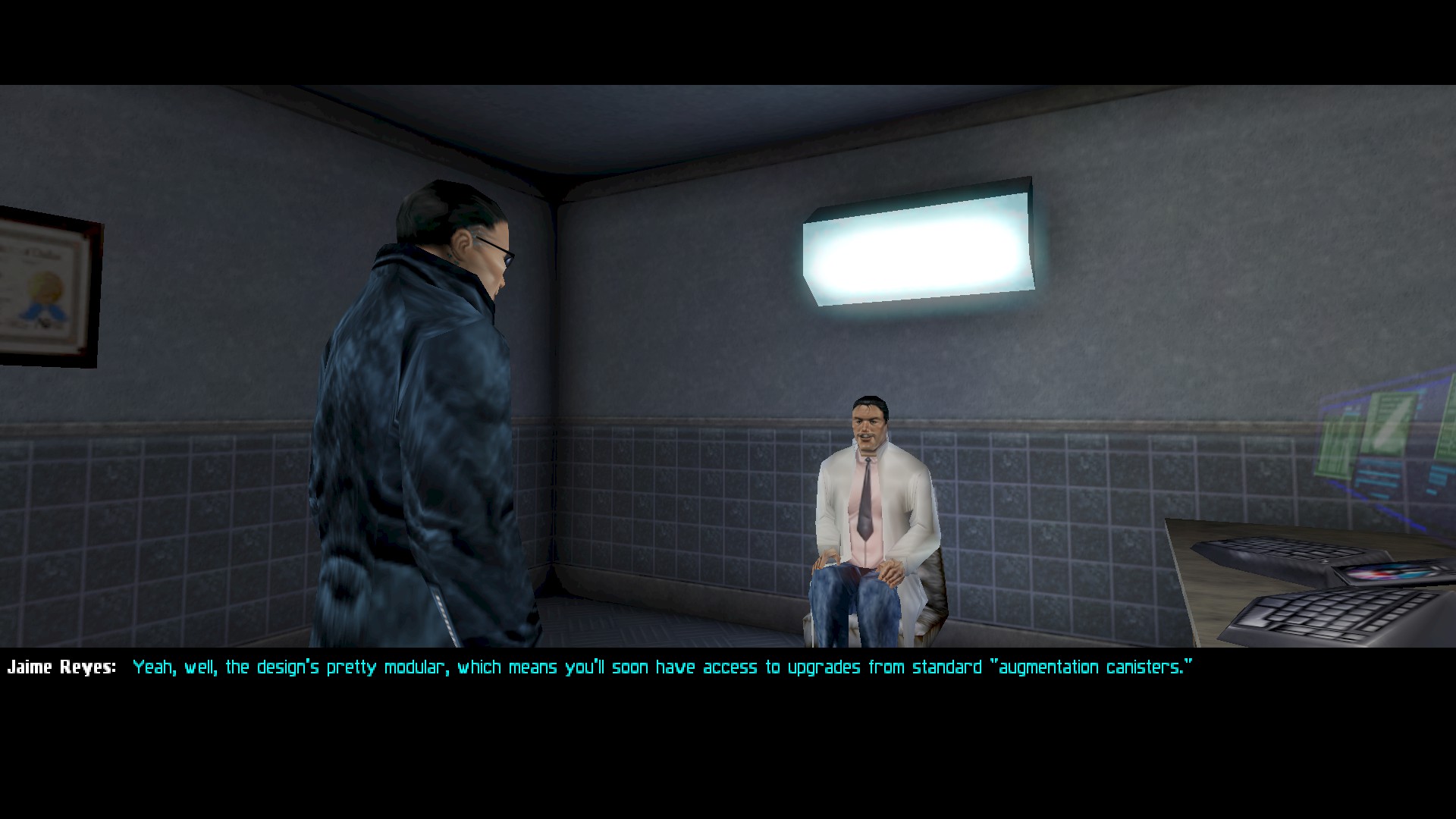
It’s a bit surreal how relevant the story in the original Deus Ex is today, a game that came out in 2000, before the 9/11 World Trade Center attack occurred, the war on terror of the 2000s, and well before COVID-19. Deus Ex’s story deals with terrorism and a global pandemic. It almost feels prophetic given when the game came out. The story is deep, nuanced, philosophical, and mostly optional if you just want to run through the game and don’t care about the narrative. There’s a lot of voice-acting, but there’s also a lot of optional reading you can do with newspapers, books, personal notes NPCs leave laying around, and emails you can read after hacking into someone’s computer. It’s probably the most reading I’ve done in a video game in a long time, if ever – and I enjoyed it. It’s Bladerunner meets The X-Files meets The Matrix all rolled into one. It’s one of the best stories I’ve seen in a video game.
Visually, there’s not a lot that can be said. Deus Ex looks like a PC game from 2000, which equates to an early PlayStation 2 game. It ran smooth after downloading the appropriate patches, with only a handful of sporadic visual glitches. However, I had consistent trouble with the brightness level in the game, which would change on its own depending if I just came out of a dark room, or there was a bright flash, or a lot of light from another source. Eventually, I just cranked up the brightness level as high as it would go and left it there. That fixed it for the most part, but not completely.
The game feels sparse in areas. There are major areas that take place in foreign cities where you would think lots of people would bustling about, but it feels empty. No doubt this was because of the limited power PCs were running on back then, but it’s a dated aspect of the game that feels odd by today’s standards.
Also, the voice-acting is hit and miss. Much of it sounds wooden and forced. JC Denton’s character is a bit understated but still sounds okay, but many of the lines from the game’s various NPCs sound dated. This was back in the days when many voice-actors for a game were recruited from the game’s development staff and professional voice-actors weren’t necessarily used in games like they are today.

VERDICT
Deus Ex is a game I’ve been wanting to beat for a long time. I made several attempts in the early 2000s, but something would always go wrong. Once I lost the disc. Another time I got about halfway through and my disc got scratched inside my CD-ROM drive and it wouldn’t boot anymore. After that, I gave up in spite of really liking it. Now with all the interest in Cyberpunk 2077, I thought I would give Deus Ex one more go, this time on Steam where there’s no disc to get scratched or lost, and I’m very glad I did. It’s an astonishingly good game for its age and still stands toe-to-toe with today’s modern RPGs.
When Nightdive Studios eventually finishes working on remakes for the System Shock series, they should be commissioned to work on the original Deus Ex. If they ever decide to give Deus Ex the same remake love they’re giving to System Shock, you won’t be able to tell the game is decades old. The gameplay, systems, mechanics, and story still feel like new, and very relevant. I’ve never played any of the Deus Ex sequels, but I fully plan on it now that I’ve finally finished the original game.
If you like C-RPGs and have never played the original Deus Ex, I can’t recommend it enough. It requires some tinkering to get it to work on today’s modern rigs, but it’s well worth the effort. It’s a very good game and maybe the best RPG I’ve ever played.
 The Gamer's Standard