
In the mid/late 1990s, Rare was the golden child of the video game console world. From 1994-2001, there was arguably no developer more celebrated and more successful. They had a long string of hits on Super Nintendo and Nintendo 64 that made them almost 1:1 with Nintendo in the eyes of Nintendo fans. A huge part of that popularity was a 3D platformer they released in 1998 called Banjo-Kazooie, and its sequel in 2000, Banjo-Tooie. Banjo-Kazooie was a graphical showpiece for its time, wowing Nintendo 64 owners with its lighting and texture work. To this day, it’s one of the best-looking games on the Nintendo 64.
Eventually, Rare was purchased by Microsoft, and all the people who made Rare what they were during that golden age left and went elsewhere. Playtonic Games was formed in 2014 of former Rare members, and their first announced game was a spiritual successor to the Banjo games, a 3D platformer called Yooka-Laylee. After years of waiting for Microsoft and Rare to make Banjo-Kazooie 3, fans prayers were being answered, although not quite how they expected: same developers, same genre, same style, but with different lead characters.
Yooka-Laylee is essentially Banjo-Kazooie 3. Everything, from the visuals, to the music and sound design, to the characters, to the writing and humor, is straight from the Nintendo 64 Banjo games. It’s a classic ’90s 3D platformer, and what are ‘90s 3D platformers all about? Collecting! Instead of jiggies you’re collecting pagies, instead of musical notes, you’re collecting quills, instead of jinjos, you’re collecting ghosts. The more you explore the different levels and collect, the more the game opens up. Collecting golden quills allows Yooka and Laylee to buy more moves, which allows them to access other areas of the different levels to obtain even more quills and pagies. The pagies allow them to access more worlds, and also expand those worlds to make them bigger with more challenges, collectibles, and exploration.
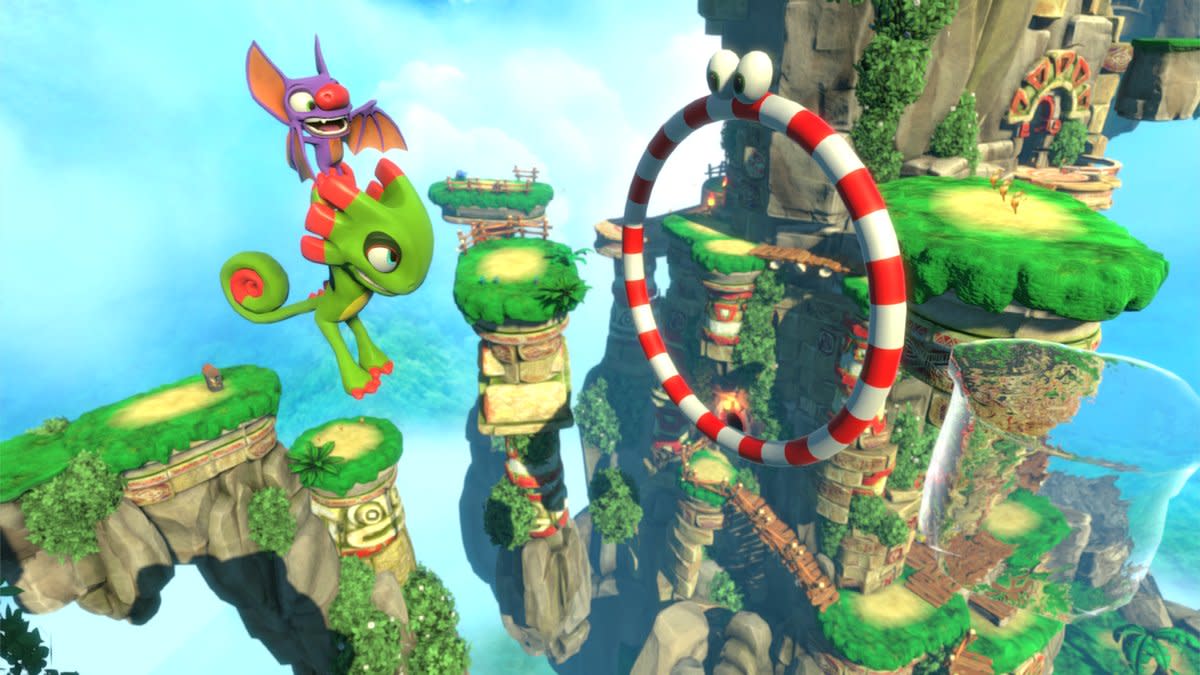
The Banjo games were always self-aware and unafraid to be as ridiculous as possible while putting the player in beautiful landscapes to run around and have fun in. Yooka-Laylee proudly continues that tradition. The writing is hilarious. The characters use the same garble-speak that the Banjo games used. Everything about it feels like the same type of characters from the same universe that Banjo and Kazooie exist in. Also, the score for Yooka-Laylee is fantastic. It’s one of the constant highlights of the game and adds a lot to the experience.
And while I loved the humor from the characters, it seemed to take priority over making a mechanically sound game. If the camera, controls, and gameplay were as good as the humor, Yooka-Laylee would’ve been fantastic. While I understand a big part of the appeal of Yooka-Laylee is its nostalgia, I was at least expecting it to feel modern in its mechanics. Not only does it not feel modern in its camera and controls, Yooka-Laylee feels regressive. The Banjo games and Donkey Kong 64 never had the camera issues and long load times that Yooka-Laylee has, and it was a constant annoyance and disappointment throughout my time with it. Also, the game has a strange hitching that occurs periodically that can be jarring and throw off your timing, especially if you’re in the middle of a jump or fighting enemies.
Yooka-Laylee’s load times are a constant plague on its pacing. It has the longest load times of any game I’ve yet to play on Switch. Animal Crossing: New Horizons’s boot-up load times are bad, but once you start playing, it’s fine. Yooka-Laylee’s load times take place any time you go to a new area. Sometimes these can be only a few minutes apart. So if you boot the game and continue from the last world you were in, the game has to load into that area for about a minute. Then once you’re in, if you need to go back to the hub world right away, that’s another sixty-second loading time. Then when you’re back in the hub world and you get to the entrance of the world you want to be in, there’s a third load time. It adds up quickly as you play, makes the experience feel technically shoddy, and interferes with the pacing of the game.
Super Mario Odyssey has load times as well, but Nintendo has always been good about disguising them with clever programming and graphical tricks. In Odyssey, when Mario sets off to another world, the load is partly disguised by the cutscene of Mario taking off in his ship and looking out the window. If you choose to skip past that cutscene, you’ll get a loading screen. But Yooka-Laylee doesn’t do anything like that. You just get a screen that says ‘Loading’ on it. Even the music cuts out.
Also, the game has major camera issues. A 3D platformer lives or dies by its camera. A bad camera in a 3D platformer can single-handedly ruin the game. Unfortunately, the camera in Yooka-Laylee is a mess, and the controls are slippery as well, which together makes the game way more frustrating than it should be.

I don’t understand how the flying in the Banjo games can feel so effortless, while in Yooka-Laylee, it’s janky. Just the simple act of landing where you want while you’re in the air feels like trying to land Maverick’s plane in Top Gun on the NES. It’s incredibly tedious and frustrating, and a big reason why is the camera. In fact, almost everything in Yooka-Laylee is tedious and frustrating after the second level of the game. It felt like a constant tap on my patience and a chore to play.
Yooka-Laylee is supposed to be a throwback ‘collect-a-thon’ 3D platformer, but the only collectible you really need all throughout the game are the pagies. You collect golden quills to buy moves, but the moves are not expensive and you can have them all bought fairly quickly. Yet there are 200 in each level, and there are five levels in the game. So that comes to 1000 golden quills to collect. So after you buy every move that’s for sale, which you can easily do in the first half of the game, there are still hundreds of quills in the game to get. I kept collecting them because I was thinking there surely would be some payoff to having them as I progressed. Right? Nope. They’re meaningless after you buy all of the moves. That’s inexcusable.
At that point, the player is left with nothing to do but wander the different levels hoping to run into a pagie they haven’t gotten yet, or a challenge they haven’t completed. If you’re going to make a collect-a-thon platformer, then go all in and make one. Banjo-Kazooie had tons of collectibles. They dialed it back in Banjo-Tooie, which was unfortunate, and is one of the reasons it’s not as good as its prequel. Yet Yooka-Laylee dials the collectibles back even further to the point that they’re almost all meaningless.
The game seems to pride itself on being retro in its writing and characters, but then seems very unwilling to jump into the deep end of the pool in its gameplay. If you want to make a collect-a-thon platformer, then you need to have lots and lots of collectibles. Yooka-Laylee presents itself as being that type of game, but doesn’t follow through. Instead, tedious mini-game challenges are substituted for exploration, collecting, and creative level design. I almost got the sense I was being trolled at times by the game with some of the challenges they have you doing. When you throw sloppy controls and mechanics on top of that, the result is a frustrating and dull experience that doesn’t come close to reaching the heights of the Banjo games it’s supposed to carrying the torch for.
Also, some sort of location system or map would’ve been very helpful in tracking down pagies. Super Mario Odyssey has a system that helps you find Power Moons in every level, and it works pretty well. Yooka-Laylee has nothing like that and you’re left to wander around hoping you run into a pagie challenge. The worlds are big enough that it’s hard to know where you have and haven’t been. Or you can use a guide which is probably your best bet.
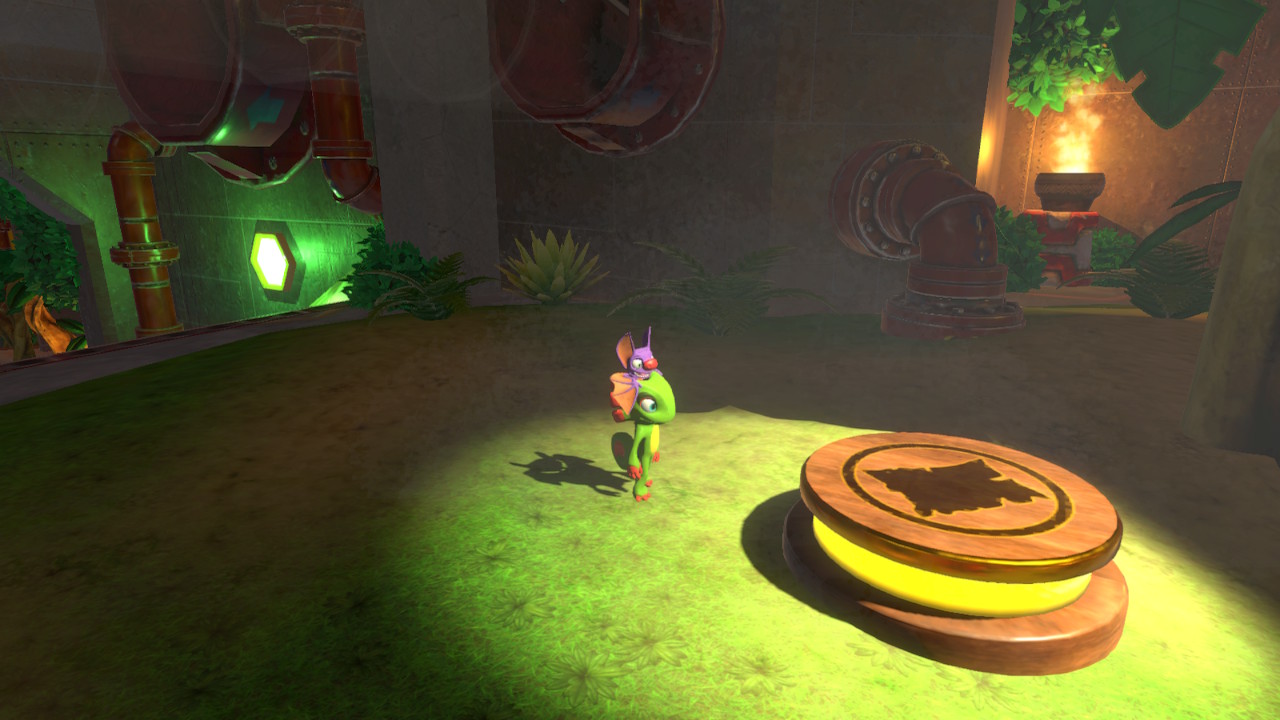
I wasn’t expecting a Super Mario Odyssey caliber game from Yooka-Laylee, but I also wasn’t expecting a game that is a significant regression from its predecessors.
Yooka-Laylee plays like a game from 1999 whose developers went to sleep in a hyperbaric chamber for 15 years and had forgotten how to make a good video game when they woke up. I say this because Yooka-Laylee plays like these former Rare developers at Playtonic Games, who made some of some of the most beloved games of the Nintendo 64 generation, haven’t made a video game since then. Or even played one. Yooka-Laylee’s problem isn’t that it’s an old-fashioned throwback, it’s that it’s a game trying very hard to use its characters, charm, and great soundtrack to cover the glaring flaws in its mechanics and gameplay.
The mine-kart sequences, which are supposed to be a nod to the Donkey Kong Country games on Super Nintendo, which Rare also made, feel nothing like the sequences from those games. In Donkey Kong Country, the mine kart levels take place in an actual mine. The mood and the music in the game reflect that. In Yooka-Laylee they take place out in the open like you’re on a carnival ride. It completely misses the point.
The enemies are boring and bland and are almost completely the same throughout the game. They’re disguised to look different depending on which area you’re in, but they all have the same attacks and make the same noises. Dealing with them gets old well before the game is over.
Yooka-Laylee doesn’t play like a game that ran out of ideas before the end to keep it interesting, it plays like a game that didn’t have many ideas from the beginning outside of nostalgia and how many mini-games they could come up with. It definitely doesn’t play like a game from veteran developers who have been making games for decades, which for me is surprising. It needed more polish time with its technical issues and its controls. Playtonic seemed to forget how important good mechanics and strong gameplay are in a 3D platformer and how it made the Banjo games unique all those years ago.

Yooka-Laylee is a game with a very specific audience in mind: fans of Banjo-Kazooie, and so I was hoping to get a modernized take on Rare’s ‘90s-era 3D platformers, much in the same way that Super Mario Odyssey is a modernized take on past 3D Mario platformers. Unfortunately, that’s not what Yooka-Laylee is. I really wanted it to be good, but I can’t recommend it but to the most ardent of Banjo-Kazooie fans. Even then, I would say, wait for a steep discount, play the first three levels, and then check out. Putting more than 10-15 hours into Yooka-Laylee quickly turns into a tedious slog of repetitive enemies, annoying mini-games, and sloppy mechanics in spite of its charming characters, hilarious writing, and strong soundtrack. It plays like the developers phoned-in this whole project, which is odd considering that Yooka-Layee was a Kickstarter game.
I very much wish Yooka-Laylee was the Banjo-Kazooie sequel I’ve been wanting to play for over 20 years now, but it’s a mirage. It has all the appearances of Banjo’s classic greatness, but none of the substance, and is the most disappointing game I’ve played in years.
Yet what gives me hope is that its issues are very fixable if Playtonic ever considers doing another 3D platformer. I’ll be much more measured in my enthusiasm if that project is ever announced, but it’s definitely something I would keep an eye on if it happened. Maybe they could even consider getting a major AAA publisher involved who knows a thing or two about making 3D platformers to help them work out their gameplay and mechanical issues.
Like, for example…Nintendo!
Just a thought.
 The Gamer's Standard