
Pop-culture subversion in movies is all the rage right now. We saw it with the all-female Ghostbusters movie that went down in flames. Star Wars attempt to elevate Rey while turning Luke Skywalker into something almost unrecognizable didn’t fare any better. Rumors about replacing Harrison Ford with Phoebe Waller-Bridge as Indiana Jones have been rampant on the internet.
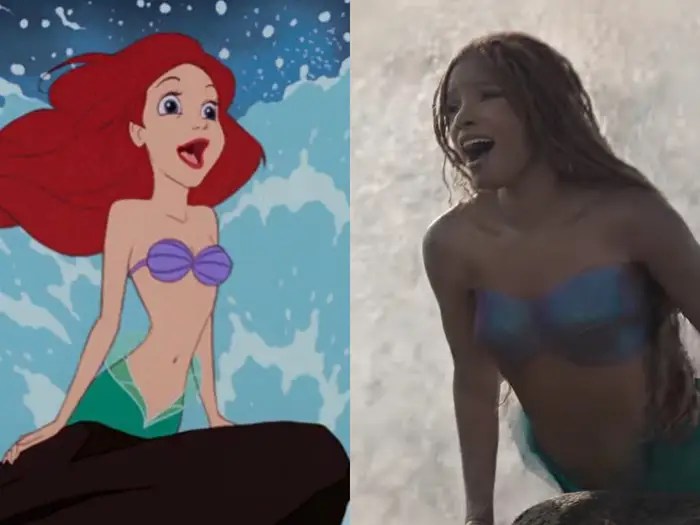
We also have the live-action remake of The Little Mermaid, in which Ariel’s character looks quite a bit different from the one we remember in the 1989 animated film. In the classic animated film, Ariel has pale skin, red hair, and blue eyes. In the new remake, they picked an actress who looks nothing like that.
Does that matter?
Contrary to popular belief, Disney did not write The Little Mermaid. It’s a fairy tale originally written by Hans Christian Andersen, a 19th century author, in which several references are made to the little mermaid’s appearance (she isn’t called Ariel in Andersen’s tale, she’s just referred to as ‘the little mermaid’). Here are a few of them:
“Her skin was as clear and delicate as a rose leaf, and her eyes as blue as the deepest sea…”
“When something like a black cloud passed between her and them, she knew that it was either a whale swimming over her head, or a ship full of human beings who never imagined that a pretty little mermaid was standing beneath them, holding out her white hands towards the keel of the ship.”
“He fixed his coal-black eyes upon her so earnestly that she cast down her own and then became aware that her fish’s tail was gone and that she had as pretty a pair of white legs and tiny feet as any little maiden could have.”
“She looked at him mildly and sorrowfully with her deep blue eyes, but could not speak…”
“Then the little mermaid raised her lovely white arms, stood on the tips of her toes, glided over the floor, and danced as no one yet had been able to dance.”
“Her skin was delicately fair, and beneath her long, dark eyelashes her laughing blue eyes shone with truth and purity.”
“The little mermaid leaned her white arms on the edge of the vessel and looked towards the east for the first blush of morning…”
So what possible reason would Disney have to change Ariel’s appearance in their new live-action remake? Ariel, the little mermaid, has pale skin and blue eyes according to the source material – it’s pretty explicit – but that’s not remotely close to what Disney wants to portray.
If the tables were turned, and anyone tried to take a young dark-skinned female character from a well-known fairy tale written 200 years ago, and replace them with a white actress, the same people who applaud this choice would be apoplectic. Disney easily could’ve cast a young actress who more accurately fits the description of what Andersen wrote, but they chose to virtue-signal instead. Perpetuating political-correctness is more important than preserving our myths, stories, and fairy tales apparently – in essence, part of our culture.

This doesn’t even go into the story changes Disney is making, in which Ariel’s whole motivation for wanting to leave the ocean is also being changed. If you’re not interested in adhering to the source material of the story you’re telling at all, at some point you have to ask yourself why you’re even bothering to retell it in the first place. However, I’m sure that kind of introspection and self-awareness from Disney is asking way too much. Nothing matters but “the message”. The story is secondary.
Subverting the work of long-dead authors who can no longer speak for themselves and defend their art is becoming worrisome. It’s a slippery slope, even if it’s only a children’s story like The Little Mermaid. I’ve heard the term ‘cultural vandalism’ used to describe this kind of subverting of classic stories, and that accurately describes what this is.
If Hans Christian Andersen was still alive, maybe he wouldn’t care what Disney is doing with his story. Maybe he would even applaud it – but he isn’t alive, and therefore it’s Disney’s duty and obligation to treat his work with all the integrity they can muster. Unfortunately, Disney has chosen poorly. If you care about the integrity of artists and authors, regardless of their ethnicity or skin color, this kind of disrespect of classic art and literature should be shunned at every turn. It’s dishonest, arrogant, and obnoxious.
 The Gamer's Standard