Xenoblade Chronicles has a unique, storied history. Originally a Japan-only RPG for the Wii in 2010, Nintendo of America unwisely decided it was unfit for consumption in North America, and wouldn’t localize it for American gamers. At the time, Nintendo fans were starved for content that was something other than Wii Sports casual games. Their response was to stage one of the most famous petitions and protests in the history of gaming: Operation Rainfall. Through various avenues, Nintendo fans in North America flooded Nintendo’s communication channels and made it known that they weren’t going to tolerate the biggest and best RPG on the Wii not being made available to them to play. Against all odds, it worked. Nintendo of America relented. They brought the game over, but only in limited quantities as a GameStop exclusive. After that, Xenoblade Chronicles was eventually ported to the 3DS in 2015, and then finally to the Switch in 2020 as Xenoblade Chronicles: Definitive Edition.
At its heart, Xenoblade Chronicles is a big, epic RPG set in a beautiful world in which two titans, the Mechonis and the Bionis, are locked in frozen combat. The peoples of the Mechonis and Bionis actually live on these massive titans, and while at odds with each other, are doing their best to live their lives in peace. Tensions spill over, events start to spiral out of control, and our heroes adventure out to set things right using Shulk’s mysterious blade called the Monado.
The three tentpoles of Xenoblade’s gameplay is combat, exploration, and story, and it seems to make a concerted effort to remove the tedious filler from the traditional J-RPG experience and keep the game focused on those elements. For example, not needing to heal outside of combat. After a battle, your characters will automatically heal. Also, there are no random battles in Xenoblade and the battles all happen in real-time. You issue commands to the character you’re controlling and your character will perform them. However, it’s not one-to-one control the way it is in a Dark Souls or Zelda game. It’s more like World of Warcraft. The whole battle and quest system is very MMO-inspired in its approach.

Xenoblade Chronicles is a really long RPG and has a lot of quests and side-quests. The NPCs will have you running around everywhere fighting monsters, collecting items, and other various tasks. There is never a lack of things to do. If creatures or enemies are too far below you in level, they won’t aggro and come after you on their own. If they’re about equal or above you in level, they will aggro if they see you. This eliminates a lot of needless fights with weak enemies, but since there are so many quests, you’ll still be getting into plenty of battles and getting your needed XP to make sure your levels are where they need to be to progress in the story. You get XP for completing quests and for exploring, and if you do all the side-quests available, your XP levels will be right where they should be as you move into the next major area of the world. It’s incredibly well-balanced in that way. After about 110 hours, the story started reaching what seemed to be a climax and maybe the end. My party was introduced to a new region that looked like it could be the final area before the conclusion. However, I noticed my party wasn’t leveled-up high enough to fight some of the enemies. So I started checking around to see if there were still more side-quests to do. Sure enough, there was. I got loaded up with yet even more quests, many of them featuring high-level enemies my party wasn’t close to being ready to take on yet. I still had work to do. Thankfully, the quest log does a good job of helping you keep track of the party’s quests. You can prioritize which task you want to complete and the map will guide you where you need to go.
However, many of the side-quests don’t seem meaningful, and involve doing rudimentary tasks for random people in whatever city-hub you’re in: fetch me this item, go talk to this person, kill ten of this creature, etc. A lot of them don’t feel important to the overall story. I couldn’t help thinking how much more engaging some of these side-quests could be if more of them were story-relevant instead of feeling like mundane tasks.
Also, the post-game content didn’t seem to be as balanced as the rest of the game. After beating the final boss, you can continue playing with your party’s current levels, items, and weapons. There are high-level quests you can take on, but not much incentive to do them if you’ve already seen how the story ends. Plus, unless you’re prepared to do a lot of grinding, you’re likely not going to be close to some of the level-99 monsters you have to take on, and will have little chance of beating. However, this applies to a small handful of quests compared to the game as a whole, and you’re only likely to care about it if you’re a completionist.
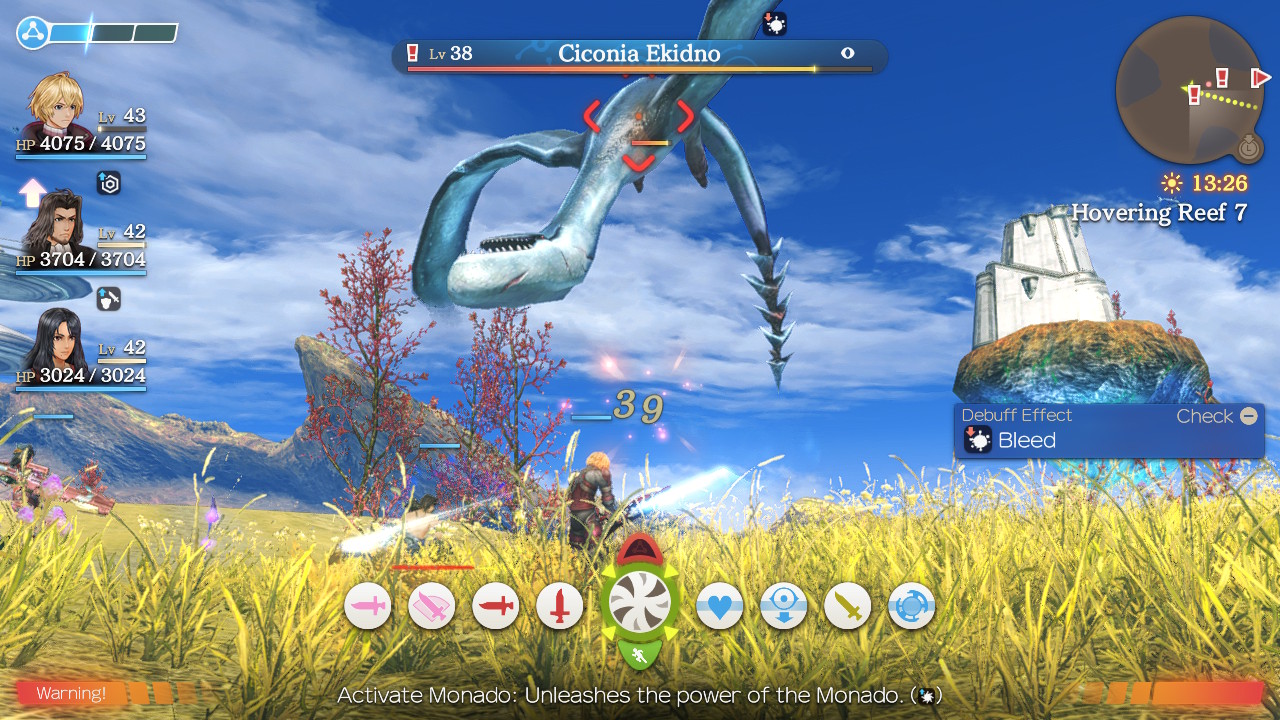
The battle system has different facets that all work well together. The basic commands you issue are called Arts. Each character will acquire new Arts as you progress through the game, and all of your Arts can be leveled-up with AP, which is acquired from fighting battles. Also, there is the Affinity system, which measures how deep your characters’ relationships are. The more two party members fight together, the deeper their affinity will become. You’re rewarded for this with short pieces of personal dialog between them that enhances the story. This encourages the player to fight with different party combinations instead of the same three members all the time. Then there is the Skill Link system that allows party members to link and borrow abilities from each other during battle. The better the affinity between characters, the more skills they will be able to link. Better affinity also results in better gem crafting.
It’s easy to get in over your head in combat. The enemies are good about ganging up on you if they have the opportunity. You’re fighting one enemy and all of the sudden you’re fighting four or five enemies. Or you can turn a corner, or come over a rise, and run right into a high-level enemy you have no chance of defeating. At that point, it’s easy to get overwhelmed and die. Thankfully, the game doesn’t penalize the player at all if this happens. If all the members of your party go down, you automatically start at the closest waypoint. You’re not penalized in XP, money, or items, and you don’t even have to reload your last save. You just continue on. It’s very streamlined and convenient without sacrificing difficulty.
In fact, the game rewards your characters with XP whenever you find a new area, which definitely provides extra impetus to go off the beaten path of the main story and explore the world.
A unique feature of Xenoblade’s battle system is the Monado’s ability to see into the future. At certain points during a major battle, Shulk will be able to see what the enemy is going to do next. The game will actually show it to you in a vision, and what the end result will be if you don’t act quickly. If the enemy’s attack you see in the vision is directed at you, you can use one of your Arts to prevent it. If the attack is directed at another character in your party, you can warn them, at which point, you’ll take control of that character and you can act to prevent the vision from coming to pass in the same way. However, you only have a few seconds, or the enemy’s attack will do exactly what you saw in the vision.

The idea of having Shulk see into the future during battle is good. However, when battle is constantly being interrupted because of his visions, it becomes intrusive really quickly. Sometimes the vision will kick in right when you’re trying to do something important like heal yourself or one of your party members who desperately needs it. Or sometimes Shulk will be unconscious already (or dead), but somehow will still be seeing a vision. When you add on top of that not being able to move if your player has been knocked down or dazed, plus the frequent QTEs you have during battle to increase the tension bar for pulling off chain attacks, the pace and flow of battle is being interrupted a lot and can get very frustrating. It makes it more difficult than it should be to get into the rhythm and flow of battle that doesn’t happen during normal battles. A more elegant way to notify the player a big attack is coming, that doesn’t involve having to constantly stop gameplay while you have to watch a vision of you or one of your party members slooooowly being killed over and over again, would’ve worked better. Thankfully, the visions only happen against stronger boss and mini-boss enemies. Overall, I like the idea, but it could use some tweaking so it doesn’t interfere with the gameplay so much.
Xenoblade’s story starts off strong, starts to lose its way in the middle portion of the game, and then absolutely takes off closer to the end. It’s well-written and most of the voice-acting is solid. The animated cut-scenes have all been remastered with new character models that look much more anime than the original Wii version did. This might not be everyone’s preference, but it makes it more consistent with the Xenoblade Chronicles sequels which also have an anime art style.
However, there seemed to be a disconnect between Xenoblade’s story and its gameplay at times. The story is about the war between the Mechon and the people of Bionis, but you hardly spend any time fighting Mechon, or even seeing them, in the first quarter of the game. The story revolves around the Mechon, but the gameplay doesn’t. You spend your time fighting creatures roaming about whatever region you’re in.

The Nopon section in particular is the weakest portion of the game. The tasks you’re doing, and the story, seemed to wander and have little to do with what’s going on in the wider world. Personally, I found the Nopon to be incredibly annoying. Every time Riki opened his mouth to talk, I wanted Reyn to pick him up and punt him into the ocean – but your mileage may vary with that. The Nopon seemed like they were trying really hard to be what the Koroks are in the Legend of Zelda series: cute while providing a little comic relief without being intrusive – but ended up just being cloying.
Even though Xenoblade Chronicles is a remastered Wii game, the world consistently impressed with its awesome sense of scale. Everything about the world of Xenoblade Chronicles feels big. In spite of its technical shortcomings, the game is still beautiful to look at. Monolith Soft did a lot to improve the visuals for the remaster from the Wii original. It doesn’t have the visual fidelity of modern games, but the art direction is strong and has some truly stunning locales. Xenoblade’s framerate runs somewhere between 30-60 FPS. To my eye, it looked to be more than 30 FPS, but not quite the smoothness of 60 FPS. Regardless, there were no significant framerate drops or issues of any kind. Most of the pop-in was kept under control, although there was significant draw-distance issues with the grass and foliage that was distracting at times with it appearing just a few feet in front of my party while exploring.
The Future Connected expansion is mostly good. It’s very similar to the core content, but with some slight tweaks to the battle system. The Affinity system, Skill Link system, and chain attacks are all gone. The Heart-To-Heart conversations are present, this time with voice-acting. There’s an island to explore, and the story beats pick up a year later after the events of the main game.
However, some enemies can now summon reinforcements in the middle of a fight, which can cause your party to get in over their head very quickly. Taking on two enemies can easily turn into six, and the extra monsters literally appear out of thin air, so you have to be more discriminate and choose your battles. In fact, respawning monsters seemed somewhat unbalanced and unpolished in the expansion, as I had monsters I had just taken out respawning right in front of my party at one point, literally seconds after I had defeated them. Also, since you eventually have a much bigger party you’re traveling with, it caused the framerate to noticeably chug during big fights towards the end. Other than that, the expansion adds more quality content to an already meaty game.

And lastly, the soundtrack was one of the absolute highlights of the game. From the rocking battle music to the Gaur Plain theme, from Eryth Ocean to Satorl Marsh, the soundtrack never misses a beat. It’s very good, and one of the best soundtracks to any game Nintendo has had their name attached to in years. A strong case could be made that it belongs in the same class with Zelda: Ocarina of Time, Metroid Prime, and Donkey Kong Country as one of the all-time great Nintendo soundtracks. Xenoblade Chronicles would be a lesser game without it.
It’s really hard to fathom why Nintendo of America initially declined to bring Xenoblade Chronicles to America when it first released on Wii in Japan in 2010, and why it took a massive online fan petition for NOA to see the light. Especially since Nintendo of Europe took on the duties of the English translation of the game. Xenoblade Chronicles is easily a top-five game in the Wii’s library, and you can make a case for the Definitive Edition remaster being a top-five game in the Switch’s library as well. It does almost everything right.
I’m convinced Zelda: Breath of the Wild would not exist if not for Xenoblade Chronicles. Although Breath of the Wild has more freedom, Xenoblade’s combat system is far better, as is its story. Monolith Soft basically taught Nintendo how to make open-world games. Good on Nintendo for acquiring them when they did. It’s turning out to be an investment that’s now paying big dividends.
 The Gamer's Standard