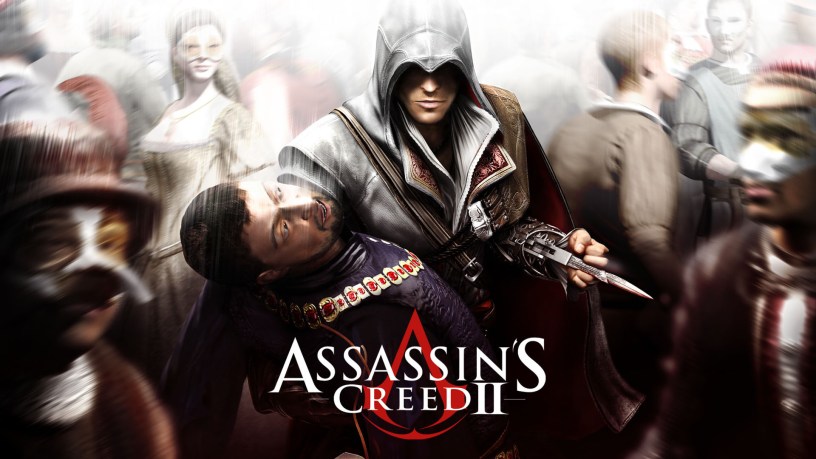
The original Assassin’s Creed showed a ton of promise when it released on Xbox 360, PlayStation 3, and PC in 2007, but was hindered by its lack of content. It was essentially an unfinished game, but was still compelling enough in what it offered to serve as a taste of what was to come for the series. It only took three years and one sequel to fulfill that promise, as Assassin’s Creed II far outpaced its prequel in every way: more missions, more events, better mechanics, better systems, better story, and better characters. Assassin’s Creed II is such a massive improvement over the original, it’s hard to know where to start, and playing it only reinforces how unfinished the first game was. There haven’t been many major AAA game series that have undergone such dramatic improvement from the first game in the series to the second than Assassin’s Creed.
While Assassin’s Creed takes place in the Middle East during the Crusades in the 12th century, Assassin’s Creed II takes place in Italy in the 15th century. The protagonist is Ezio Auditore de Firenze, the son of a prominent Florentine banker, a passionate, somewhat headstrong young man who gets caught up in the quiet war between the Templars and the Assassins.
In place of Altair’s arrogance from the first Assassin’s Creed, Ezio is much more affable and approachable. He’s still an assassin and not to be trifled with, but he’s much easier to empathize with and root for. The story starts out as one of personal revenge, but pivots into Italian politics and scheming between families warring for power. Every character and location you see in the game is from real, documented history. There are lots of Italian names, families, buildings, and locations to learn, many of them not easy to pronounce. Thankfully, the game documents everything for handy reference if you need it.

Assassin’s Creed II’s gameplay revolves around Ezio’s main assassination missions, side assassination missions, courier missions, beat ‘em up missions, races, climbing viewpoints, retrieving codex pages and treasure chests, and decoding glyphs. Not to mention having to deal with bullying and constantly vigilant guards who always seem to be itching for a fight. There are multiple cities to do this in, which gives Ezio plenty to do. There’s also his hometown and villa where he lives with his uncle Mario. Ezio can invest money into the businesses, the church, the bank, and even the thieves guild and the brothel there, to bring it back to life as a place of commerce.
While in the first Assassin’s Creed, there were meaningless flags hastily strewn around every region to collect, Assassin’s Creed II has treasure chests full of money to find. Currency can be used to purchase improvements for uncle Mario’s villa, but more importantly, improvements to Ezio’s weapons and armor, which aren’t cheap. Ezio can also hire mercenary soldiers or prostitutes whenever he needs a convenient distraction. Feathers are also spread around like Easter eggs to find, which are tied to aspects of the story that I won’t go into because of spoilers.
The assassin’s toolset has been expanded from the first game as well. Everything from the first game makes a return, but Ezio’s arsenal also includes poison knives, smoke bombs, a firearm, not to mention expanded training in melee weapons. Combined with his agility, he’s a fighting machine and his reputation as such starts to spread across Italy. However, switching weapons in combat is too slow and clunky. A few of Ezio’s main weapons are mapped to the d-pad for easier access, but it still takes him too long to actually switch to the weapon you choose. It’s not nearly snappy enough. This can have serious consequences if you need to change weapons in the middle of a fight with a guard guard bearing down on him.
Also, the game will sometimes reset the weapon you’ve equipped back to Ezio’s wristblade, which is his default weapon. So if you’re a player like myself who doesn’t see the need to kill every guard who confronts him, maybe opting to disarm them instead with fisticuffs, you might accidentally kill them anyway if you don’t make sure you have his fists equipped as weapons instead of the blade. I accidentally killed several pickpockets this way while trying to tackle or punch them out. Frustrating.
And yes, pickpockets are another new wrinkle in Assassin’s Creed II. There’s always a pickpocket running around whatever city Ezio is in, who runs away every time he sees him, yelling about how evil and murderous he is. If you happen to run him down and catch him, you find that he’s stolen money from you and he begs you not to kill him.
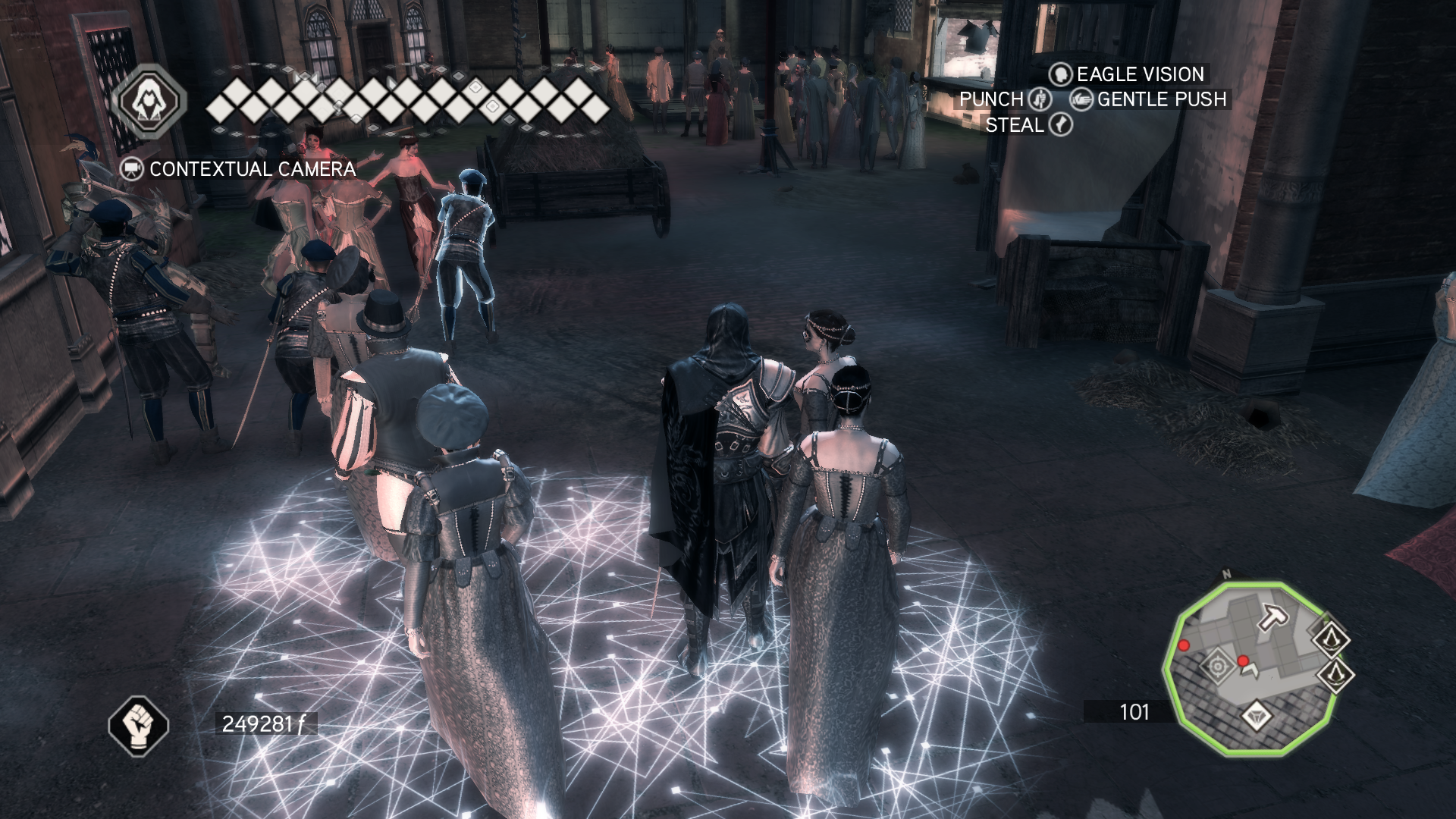
Hiding in plain sight is a mechanic that’s more fully brought to life in Assassin’s Creed II. Ezio can hide in any group of NPCs that he happens across. This comes in handy while following a target or escaping from vengeful guards who are chasing him. Given there are a lot of NPCs pretty much anywhere he goes, there are lots of hiding places to choose from when they’re needed. While touching any water in the first Assassin’s Creed meant instant death, Ezio is also quite the swimmer. Not only can he swim, he can high dive as well. This adds another element to the gameplay as he traverses the different cities he’s in, especially when he’s trying to escape hostile guards.
The game features real Italian landmarks in the cities Ezio visits. In fact, he’s even given a tour of one of the cities during his first visit there. The game will always tell you when you’re visiting a historical landmark for the first time, and if you want to read about its history, it’s all filed away for your perusal whenever you want. The problem is that the map doesn’t keep track of the names of the specific landmarks after Ezio has visited them, so if you need to find them again, good luck. The map tells you nothing other than the general shape of each of the landmarks and the area where they’re located. However, their names are not provided. This becomes important during Ezio’s search for the glyphs that are located on some of these landmarks. You’re told in your menus on what landmark they’re located, but since the names aren’t provided on the map, you have to make an educated guess where you think they might be based on the picture you’re given.
Every other bit of information from the story the game is telling is carefully cataloged and easy to find, but somehow, Ubisoft managed to not put the names of important locations you’re expected to find on the map. It seems like when you’re making a map, putting the name of important locations on it would be the first thing you would do. That’s, you know, the whole point of having a map in the first place. It’s an incredibly short-sighted omission that had no reason to be there, and added unnecessary tedium to the overall experience. I have no idea what the rationale for it could’ve been. Dumb.
Assassin’s Creed II has a solid soundtrack and a lot of voice-acting. In fact, there’s so much spoken Italian, it made me want to learn the language. Enough of the voicing is in Italian that it’s probably a good idea to have subtitles on from the beginning. That being said, the acting is all good and contributes well to the story. Ezio’s voice-actor in particular does a fantastic job. The ‘Requiescat in Pace’ he delivers after taking down an assassination target as he guides them to their final rest is very well done.

The only thing holding back Assassin’s Creed II is its engine. Assassin’s Creed II doesn’t run any better than its prequel. Even for a game that came out in 2010, it doesn’t perform well. If Ubisoft were ever to do a remake, this would be the primary thing that needs fixing. The framerate is all over the place and shadows and textures are constantly popping in and out. You get used to it as you play, but it’s still very noticeable and apparent. Also, I had several crashes. Overall, it’s one of the sloppiest PC ports I’ve played from any developer.
As bad as Assassin’s Creed II’s framerate is, there’s a workaround that mitigates it somewhat. It involves booting up the game, going into your task manager and changing the affinity of one of your CPU cores. It’s not difficult, but it’s something you have to do every time you boot the game up, and as a result, is still a pain. Frame drops are still common, but they’re not as egregiously bad.
Even though 15th century Italy doesn’t exist anymore, Assassin’s Creed II made me want to take a trip there. Just like its prequel, it’s a game that draws you into the time period it exists in and crafts a game in which you feel like you’re taking part in real history and interacting with real people from that time period. After putting 78 hours into Assassin’s Creed II, I was sorry that it was over, but it also made me look forward to its two direct sequels, Revelations and Brotherhood, even more to see what the future holds for Ezio, and to learn more about Italian history. If not for yet another technically sloppy Ubisoft PC port (see also Far Cry 2 and Prince of Persia: The Forgotten Sands), Assassin’s Creed II would be one of my favorite games of all time. However, the egregiously bad framerate and draw-distance issues hold it back from achieving the true greatness its gameplay, story, and characters deserve. That being said, it shouldn’t discourage you from playing it, but maybe consider getting it on Switch or some other console if you don’t want to deal with the task manager workaround I spoke of earlier. That being said, Assassin’s Creed II lives up to its lofty reputation as being one of the best action-adventure games of all time. It’s well-deserved.
 The Gamer's Standard