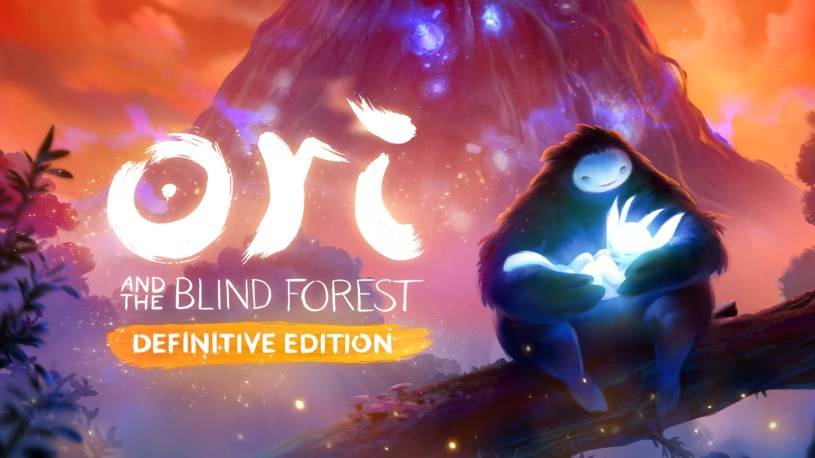
The 2D action-platformer (Metroidvania) has enjoyed a lot of popularity as of late. While the genre has been around for almost four decades, with the rise of indie game development, it’s become much more mainstream, and its influences are felt even in the AAA game space. One of the most popular and well-known Metroidvanias (if you can call it that) of the last ten years is Ori and the Blind Forest from Moon Studios. Let’s take a look:
Let’s get the obvious out of the way: Ori and the Blind Forest is a beautiful game, possibly the most visually stunning 2D game I’ve ever seen or played. The visuals, music, and story are all amazing, a 12/10. Ori’s lush 2D vistas and rich soundtrack never wear thin, to the point that the platforming and combat almost seem like an afterthought and are just there for something to do and an excuse to look at the graphics and listen to the music. There aren’t many games I could recommend on the visuals alone, but Ori sure comes close. This can’t be overstated enough because it’s the driving force of the experience along with the story, which is well-told and fits perfectly with the aesthetic.
They’re so good that it almost completely compensates for the repetitive combat, repetitive enemies, pacing issues, too-frequent gotcha moments, and at times awkward platforming mechanics. Almost, but not quite.
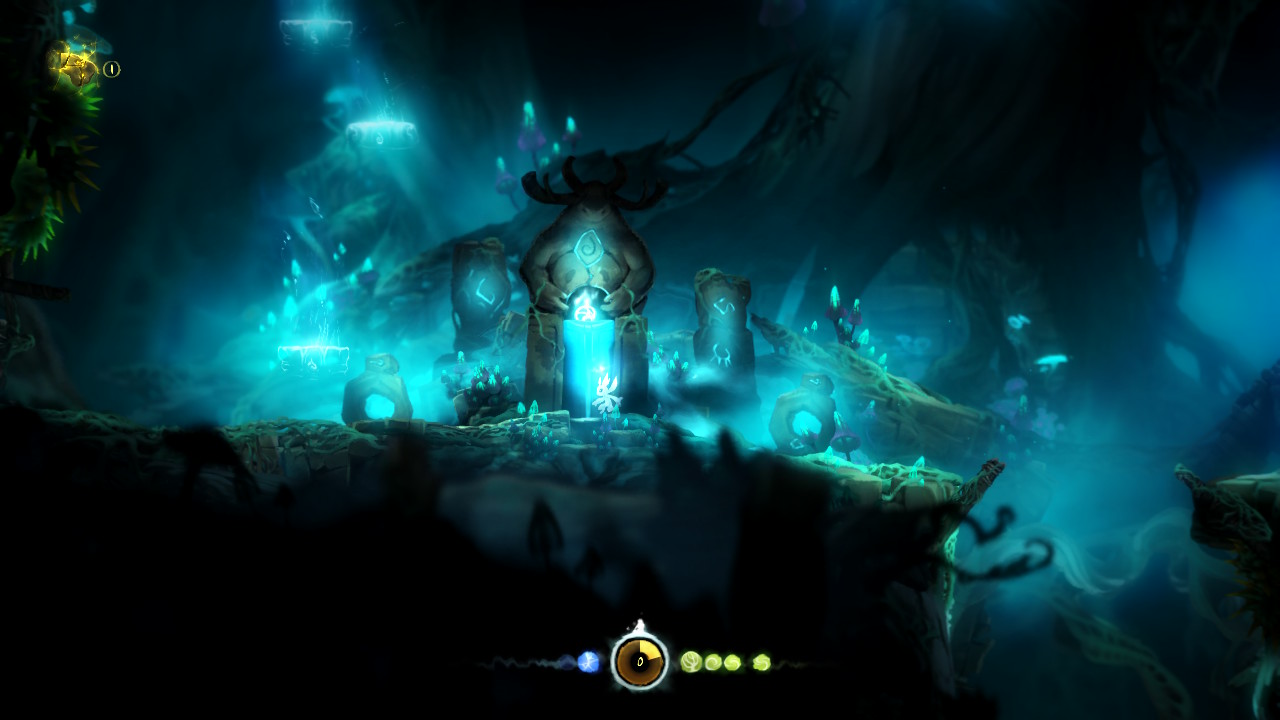
The three pillars of a good Metroidvania 2D action-platformer are exploration, platforming, and combat, and keeps a good balance between those pillars with its pacing. Ori does exploration moderately well, platforming pretty well, but its combat leaves a lot to be desired. Ori doesn’t make a good Metroidvania, but as a straight 2D platformer with light exploration and power-ups, it does okay. Its superb visuals and very strong soundtrack do a lot to cover its flaws. However, if you strip the visuals and music away, there are better platformers out there, and way better Metroidvanias out there. However, Ori and the Blind Forest is worth playing just as a graphical showpiece, even when the game itself is driving you crazy. Again, it’s a really pretty game.
It’s important to go into Ori with the proper expectations of what it is, and what it is not. Despite what you may have heard, and my intro to this review, Ori and the Blind Forest is not a Metroidvania, or at least not much of one. It’s a 2D puzzle-platformer with light Metroidvania elements. For all the comparisons between Ori and Hollow Knight, the actual similarities between them are few. Hollow Knight’s gameplay is mostly about exploration, combat, and boss fights with a few difficult platforming sequences, whereas Ori is mostly about platforming. At best, the combat gets the job done, but isn’t a reason to play the game. In fact, it’s the single weakest aspect of the whole experience. Play Ori for its eye-candy, music, and story because that’s what the game is built around, and what it does mostly well.
That needs to be said because if you go into Ori and the Blind Forest with wrong expectations (like I did the first time), you might end up frustrated and disappointed. I went into it expecting an easy-breezy Metroidvania. Even when I adjusted my expectations, it took time to get accustomed to the game’s idiosyncrasies and understand what it was expecting from me. Even after beating the game twice, I never fully adjusted to the floaty platforming mechanics, and at times finicky controls.
For example, as someone who has been playing 2D platformers for decades, it’s somewhat ridiculous that Ori’s standing vertical jump is so nerfed and weak from the beginning of the game. Ori can barely get off the ground when he jumps. It’s forgivable in the beginning because you’re likely thinking that his jumping ability will improve, which it does – somewhat. (Light spoilers here.) Eventually, Ori acquires a double-jump, which helps him with his horizontal agility, left to right and right to left. However, his vertical jump barely improves.

Later on, the game tries to mitigate this by giving Ori an ability to target enemies and enemy projectiles to vault himself higher into the air when he needs to jump vertically. It’s a pretty fun mechanic, but I couldn’t help thinking that it could’ve been totally unnecessary if Ori had better vertical jumping ability from the beginning. Almost like they intentionally nerfed his vertical agility so they could add this mechanic later on in the game. It’s odd controlling a character in a platformer who can’t get off the ground very well. It takes some getting used to. Having to rely on enemies and enemy projectiles just to jump effectively in a platformer, a genre that is all about jumping, feels out of place. Jumping in a platformer should always feel graceful, smooth, and almost effortless, and most importantly, fun. The vertical jumping in Ori can feel laborious, especially the double-jump which doesn’t even work that well if Ori needs to gain any height. Also, when Ori is able to get into the air, the physics feel floaty. It feels like it takes him longer than it should to come back to the ground.
Ori also embraces some of the worst aspects of classic 2D platformers from the past: annoying and repetitive enemies, shallow and repetitive combat, enemies that respawn way too quickly, gotcha moments featuring off-screen enemies you can’t see that ambush Ori, and stone blocks that will randomly crush him without warning. If you know they’re coming, they’re manageable, but playing for the first time, your chances of survival are low. The enemy respawn rate in Ori is the worst I’ve seen in a 2D game since Ninja Gaiden on the NES. There’s little satisfaction in defeating any enemy because you know they’re going to quickly respawn in a few minutes, or sometimes even a few seconds. Killing an enemy is usually just a brief respite for yourself to figure out where you’re going and what you’re doing next.
The combat is very basic. Ori has a lightning attack that requires nothing from the player but mashing the Y-button. Ori has to be somewhat close to the enemy for his attack to even target the enemy, which makes it harder for him to evade any attacks from the enemy coming his way. Not impossible, but harder. Overall, the combat is pretty mindless at first, but Ori does get power-ups later on that are a little more exciting. Nothing like Screw Attack in Metroid, but it involves a little more than just button-mashing.
Ori suffers from too much visual clutter at times. The foreground graphics can physically block things you need to see on the screen. Sometimes it can be a tree branch or a clump of grass, but Ori has a really bad habit of being so preoccupied with its own visual prowess that it hinders gameplay. Ori’s enemies and platforming are not always easy, and if you’re going to make a difficult game, it goes without saying that the player should always be able to see exactly what they’re doing at all times. Not one pixel of the screen should be obscured by objects in the foreground. Which means Ori shouldn’t be taking damage from spikes or a projectile from an enemy that is partially hidden by an object in the foreground. Bad design. Yes Ori, we see how pretty you are, but we need to be able to always see what we’re doing. Stop showing off.
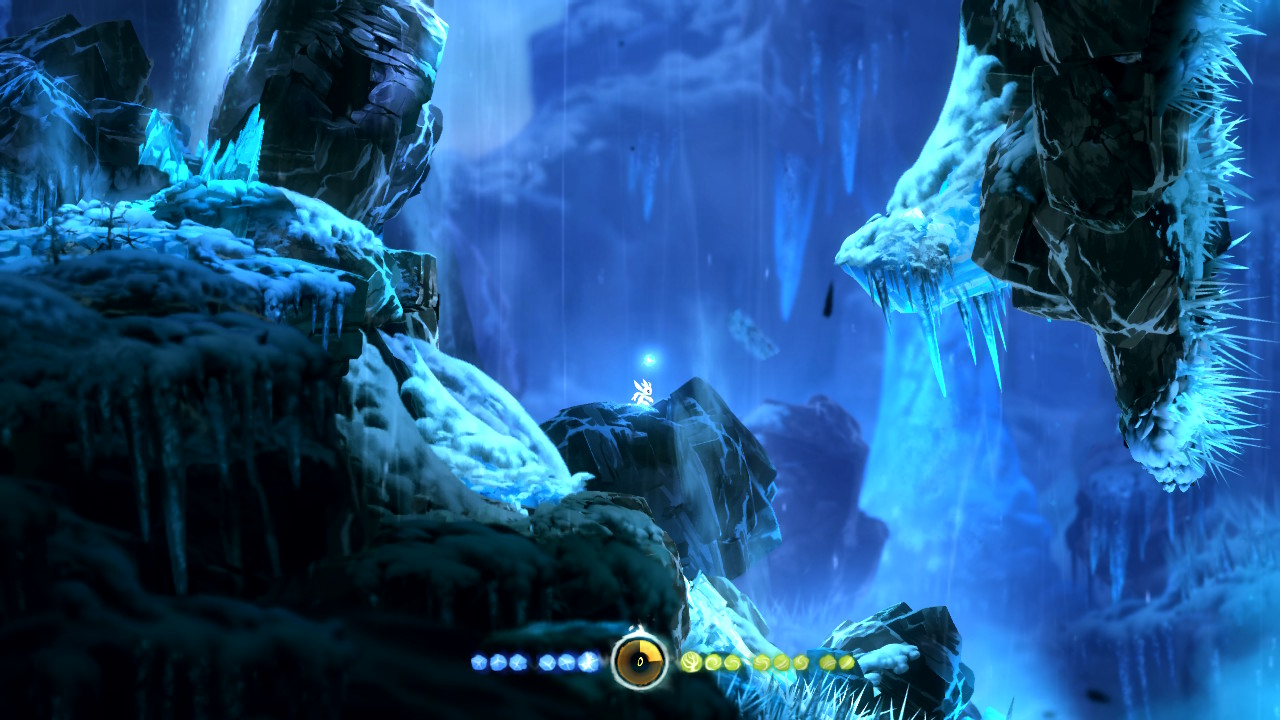
That being said, I don’t think I’ve played a game with more spikes and thorns. There are spike/thorn hazards everywhere. Many times you might not see them until it’s too late because they blend in with the rest of the game’s visuals, or you might mistake them for grass and weeds and walk right into them not knowing what they are. Other times, you might think an object is a safe platform for Ori to jump on only to find out too late it’s just more background or foreground visual dressing.
However, games like Ori are not meant to be played just once. They’re meant to be replayed over and over again, and as you do and get to know the game better, it can be quite good. My first playthrough compared with my repeat playthrough were different experiences. My first playthrough was one of puzzlement as to why the combat was so bad, surprise that the platforming was more difficult than I expected, frustration that the jumping felt off, and disappointment that Ori’s power-ups weren’t that exciting, or that it didn’t fundamentally change the gameplay like in a Metroid game. My second playthrough was much more pleasant as I better understood the mechanics and expectations of the gameplay. It was almost like two different experiences with the same game, and it allowed me to better appreciate the visuals, music, and story since I wasn’t constantly in survival mode wondering what enemy or hazard was going to suddenly ambush and kill me next. In the end, despite my complaints, I kept coming back to it and ended up playing through to the end twice at 100% completion.
So your first time going through the game, you might die a lot depending on your skill level, but one of the best decisions Ori makes is letting you save wherever you want. Make liberal use of this as it will spare you a lot of frustration.

So suffice it to say, if you have a hard time with Ori’s gameplay, stick with it because you will get better. Also, I would recommend using the analog stick on your controller, and not the d-pad, as the vault-jump power-up I spoke of earlier is designed around the analog stick and is almost broken using the d-pad.
If Ori’s gameplay was as good as its visuals, it would be a legendary game. I wanted to like it more than I did because of how good it looked and how good the soundtrack and story are. That’s not to say Ori is a bad game by any stretch, because it’s not, but there’s a definite gap between what it does well and what needs work. I kept wanting and waiting for the gameplay to live up to the promise of its visuals, music, and story, but it never quite got there. Close at times, but not quite. That being said, it’s still a strong 2D puzzle-platformer that should be played by as many people as possible. There’s a lot to like about it. Unfortunately, the annoying, repetitive enemies, the tedious, repetitive combat, the iffy platforming mechanics, at times questionable level design, and at times awful trial and error pacing can make Ori an incredibly frustrating experience. Not always, but often enough to hold it back – but it always looks amazing doing it. Again, that can’t be overstated enough. It’s a very pretty game, is accompanied with a great score, and has an endearing story that is well told. All that being said, Ori and the Blind Forest is worth your time and money, especially if you can get it during a sale. It’s definitely worth experiencing.
 The Gamer's Standard