Supergiant Games has become one of the darlings of the video game industry, thank in large part to Hades, which was a massive success critically and commercially and put the developer on the radar of millions of gamers. However, Supergiant had a small catalog of titles before Hades. Their first game, Bastion, I played and reviewed last year, and liked it quite a bit. Enough that I was very much looking forward to playing their follow-up to Bastion that came out a few years later: Transistor.
To say Transistor doesn’t live up to Bastion’s promise is an understatement. Putting it in the same league with Hades isn’t even worth discussing. Unfortunately, and to my extreme disappointment, Transistor is far inferior to both of them.
My expectation for Transistor is that Supergiant would take everything they did in Bastion, build on it, and do it even better. Instead, they did the opposite. In fact, there’s little that Transistor does that Bastion didn’t do better.
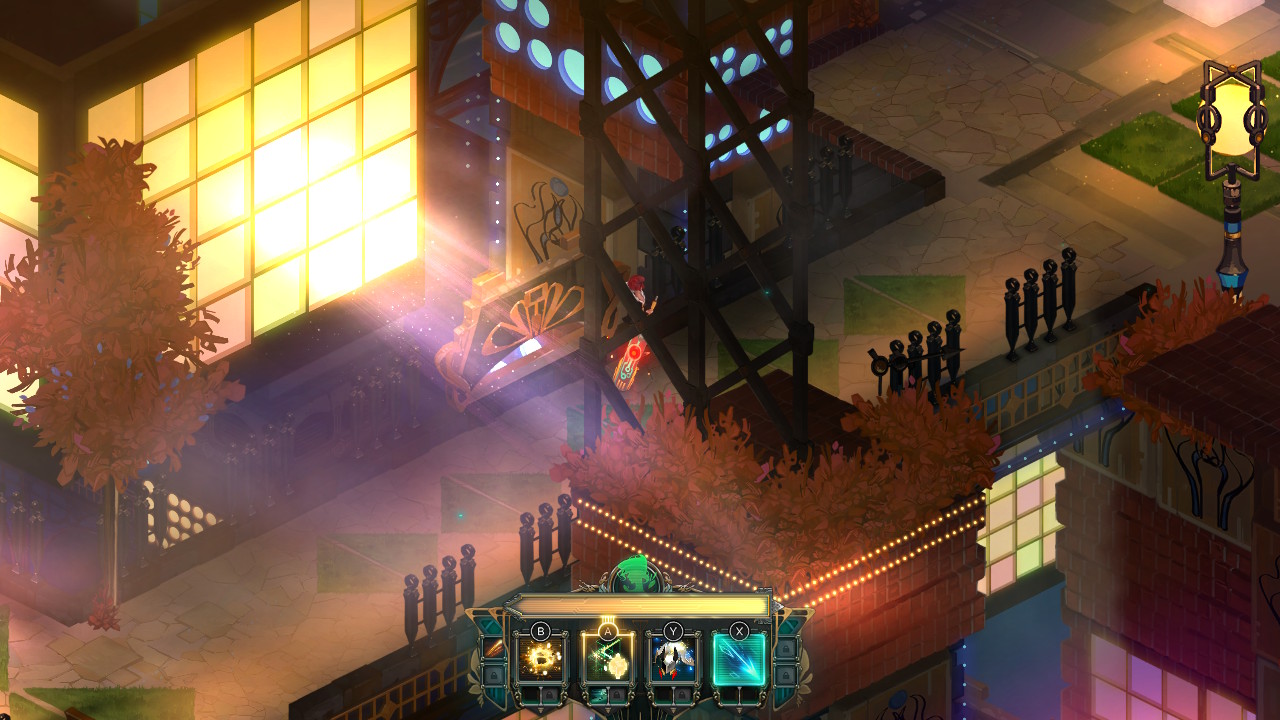
You start the game as a girl named Rose who’s carrying around a sword that talks to her. You’re not told what the sword is, who Rose is, or why the sword is speaking to her. They scaled back the constant narration that Bastion has, but since the sword is still talking to Rose frequently, it’s almost the same thing. Even though the sword is constantly commenting about the world and the different people Rose is supposed to know, I had no idea what was going on. The narrative tries to be artsy and progressive in how it’s told, but it comes off as being pretentious and obtuse.
What I learned about Rose in the first two hours of gameplay: her name is Rose.
What I learned about Rose in the second two hours of gameplay: she’s a singer?
That’s it. I learned nothing about the sword, very little about the world, and where all these robots are coming from that all want to kill her for some reason. Maybe the purpose was to add story flavor to the game, but he/it is just annoying. Anyone who’s played The Legend of Zelda: Skyward Sword, knows all about chatty swords that talk too much. Maybe Supergiant never played Skyward Sword, but if they did, they didn’t learn the lesson: companion characters who are too verbose quickly become irritating. It might’ve been better if Rose actually said anything in response, and then maybe there could be some conversation between them, and I could’ve actually had some idea what was going on in the story – but she doesn’t.
However, all these faults would be forgivable with a solid combat system. Unfortunately, not only does Transistor not provide such a system, the combat is the worst aspect of the game. All Supergiant had to do was take the combat in Bastion, or something similar, and put it in Transistor, and maybe build on it. They didn’t do that. When your game is supposed to be an action-RPG and the worst aspect of it is the combat, that’s a problem.
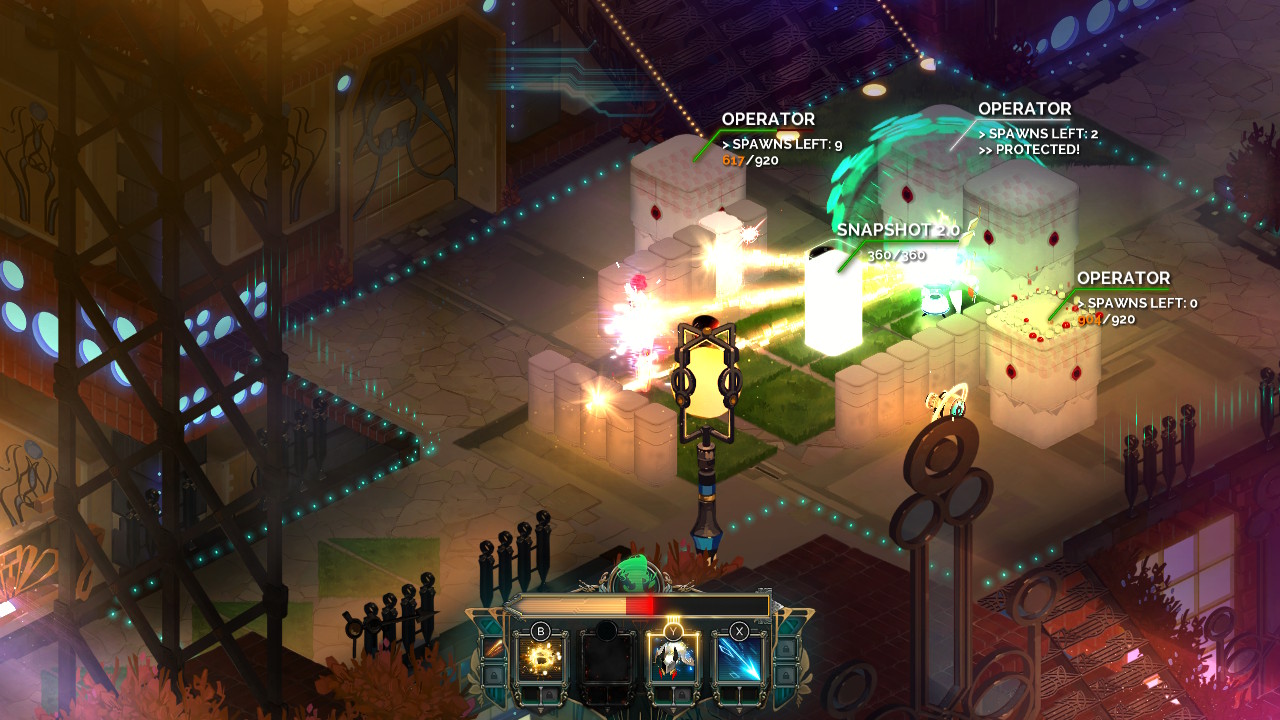
The game is linear in which you do as much exploring as the flow of the gameplay will allow, and then inevitably, you’ll enter a combat zone where barricades rise out of the ground for some reason and robots appear who all want to kill Rose. Why? Don’t know. The combat area you’re in gets closed off by an invisible barrier, and she’s forced to fight. Rose has the ability to stop time and plan her attacks in advance by pushing the ZR-button, then pushing the ZR-button again to carry out the attacks, somewhat like turn-based combat. Except it’s really bad turn-based combat because as soon as Rose is finished attacking, she can’t attack again for a good five seconds. For reasons that are never explained, her abilities need to “refresh” and she’s basically a sitting duck during those intervals during which time the enemy is free to open-fire on her. So the only thing she can do is run away or hide behind a barrier. She can’t defend and she can’t counter and since she’s somewhat slow, you can guess how effective that is. Also, you can’t heal during battle, yet somehow, Rose’s life meter is refilled after every battle is over. You’re never told why.
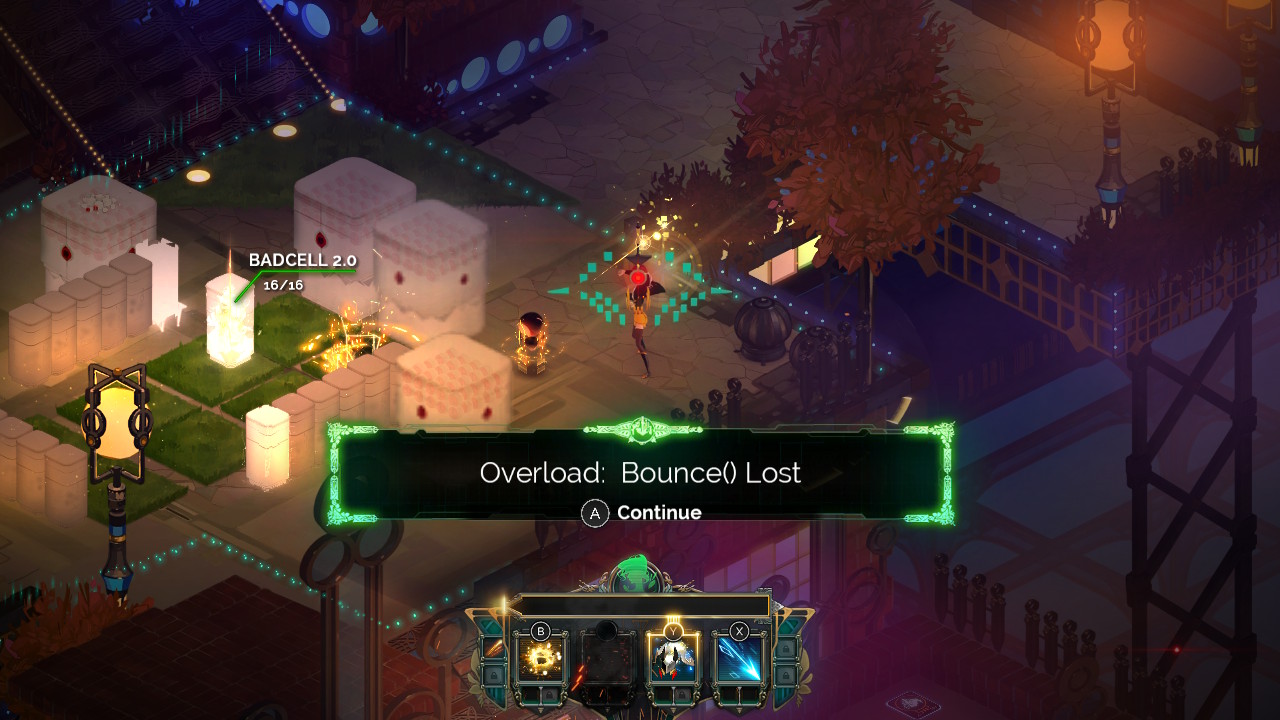
Also, like I just mentioned, Rose is slow. Every enemy in the game is faster, quicker, and more powerful than she is, and that never changes. She never feels strong or capable, and the sense of character progression is negligible if not non-existent. If she takes enough damage in a battle, Rose will start losing her attack abilities. Then when the battle is over, instead of just returning her abilities back to the buttons you had them mapped to, the game makes you go to an access point, and reassign and remap the abilities you lost. Every time. Again: tedious. Again: dumb design decision.
The combat has no flow to it. When you’re in a fight, you spend most of the time with the game paused trying to figure out what to do next. You give Rose some commands, you unpause the game so she can carry them out, and then many times have to pause the game immediately again before the enemy attacks and she takes massive damage or dies.
After the fight, your sword companion will make some cryptic comments and you move on to the next little bit of exploration followed by more barriers and more robots. That’s the whole game, over and over. Boring.
Also, certain enemies you fight will photograph Rose during combat, and the game will flash pictures of her in the middle of the screen every time a picture is taken while you’re trying to fight. It’s incredibly annoying and distracting. Even if Rose is clearly hidden behind a barrier, they will somehow keep taking pictures. I can’t imagine what the reasoning from the developers was for it. Sure, it’s stylish, but it makes the already bad combat objectively worse. Hence the subtitle for this review: style over substance. That’s Transistor in a nutshell.
There’s so many bad design decisions made in Transistor, it makes me wonder if this is really the team that made Bastion and Hades.
Transistor perhaps could’ve been more tolerable if the story did a better job of fleshing out the world, the characters, and the events. Who is Rose? Why did she randomly find a sword in the beginning of the game? What is this voice speaking to her from the sword? What are these robots? Why are they randomly popping out of the ground, and falling out of the sky, and trying to kill her? Why aren’t there any other humans around? (I’m serious, I never saw one other human.) Providing better story context and easing the player into the combat might’ve helped the experience not feel so slipshod and unfinished.
I did something I don’t often do with a game I’m reviewing: I didn’t finish it. Trust me, I tried, but the combat in Transistor is so bad, I had to stop. I even did something else I don’t usually do with a game I’m reviewing: I looked online to read other opinions on the game before finishing my review. My intention was to see if the gameplay gets any better, or if what I had experienced so far is all Transistor has to offer. Was I missing something? Is there any progression in the gameplay at all? Is this all the game has to offer? Does it get better? The answers I found: nope, nope, yep, and nope. It’s just more kill-areas with tedious combat and more cryptic story. That being said, I got about halfway through the game from what I could tell looking online.
The music is adequate, but some of it sounds out of place and doesn’t seem to fit in the context of the futuristic world that Transistor takes place in. Too much of it sounds interchangeable from the music in Bastion.
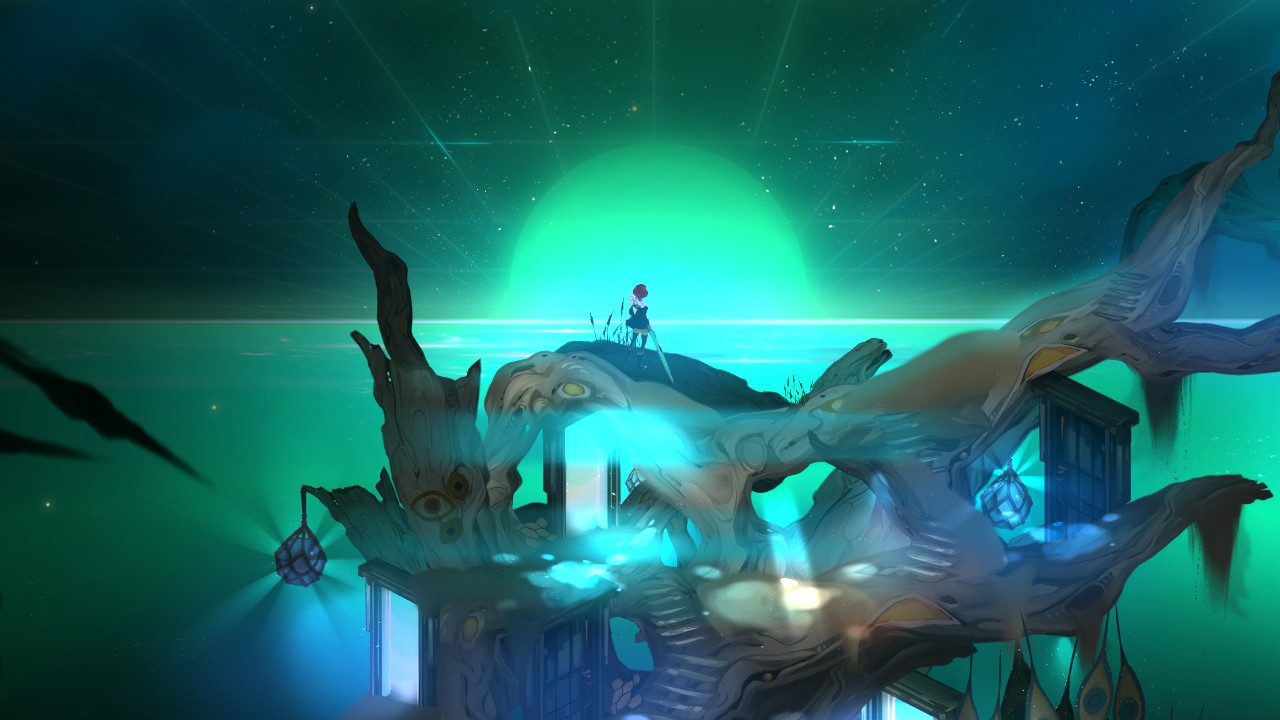
The visuals are probably the best aspect of Transistor. It looks like a futuristic, sci-fi world somewhat akin to Bladerunner, but with a little more classical flare. Lots of dark streets and bright lights. It’s a pretty game to look at, and a quick, sleek, hard-hitting battle system could’ve complimented the world so well.
VERDICT
If you played and loved Bastion and/or Hades and are curious about Transistor, be warned. Transistor plays nothing like either of those games. It’s a half-baked, unfinished, futuristic version of Bastion. The whole game is kill-areas full of robots set to electro-jazz music, pretty visuals, a plodding battle system, and a story that seems determined to be as obtuse as possible.
The only aspects of it that seem fully realized are its visuals, music, and voice-acting. The story is cryptic and not that interesting. The combat is dull at best, frustrating at worst, and Rose’s upgrades don’t seem to make much of a difference in a fight. There’s no sense of character progression and she never feels powerful. With fully fleshed-out combat like in Bastion, Transistor easily could’ve been a really good game, but the system they implemented almost single-handedly ruins the experience. Not to mention the linear, killroom-heavy pacing.
If you want a pretty game to look at, I could recommend other indie games that are visually pleasing that have infinitely better gameplay to go along with them. I’m not sure why Transistor was made or what Supergiant was trying to accomplish with it. It plays like they were more interested in making an interactive art-piece than a competent, fun, and satisfying video game. Not recommended.
 The Gamer's Standard