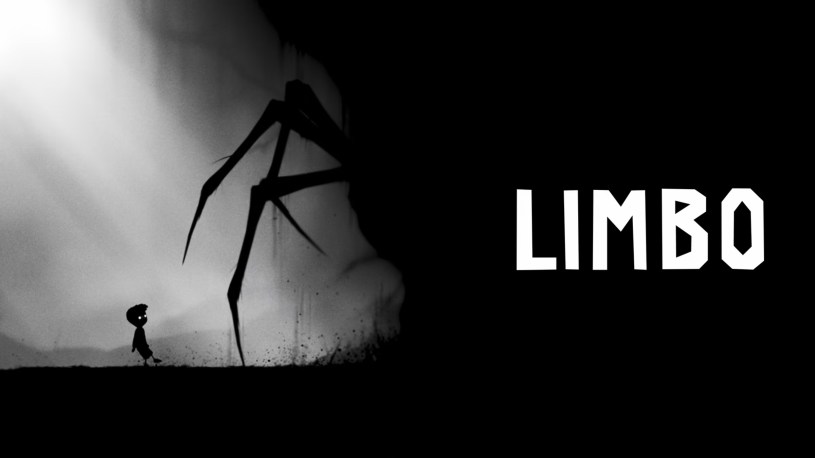
LIMBO is a moody 2D puzzle-platformer from indie developer Playdead.
You play as a young boy who’s name is never given and he never speaks a word. He’s lost in some sort of stark dreamscape and doesn’t have any special powers or abilities other than his wits. He doesn’t jump high or move very fast, yet the gameplay never drags or gets dull. The visuals don’t use any color other than black, white, and grey, and yet the world still feels alive. The use of shadow and light in the visuals is very well done.
LIMBO doesn’t offer one piece of either spoken or written dialog, yet still manages to tell a poignant story through its art style, visuals, and action. The game’s tone does an excellent job of communicating loneliness and isolation without saying anything.
The puzzles start out simple enough, but not too simple. Avoiding traps, pushing and pulling crates, light platforming, etc. slowly give way to situations where you have to use gravity and momentum, and there are times where quick reactions spell the difference between life and death. However, if you do die, there’s no penalty and you start where you left off.
LIMBO is more puzzle game than platformer. The difficulty curve of the puzzles is done well. It eases you in and slowly turns the heat up. The controls are simple and the game does an excellent job of teaching the player the basic mechanics, then builds on those mechanics. All the puzzles are clever, and as a result, you feel clever when you solve them.

Solving puzzles and dodging traps in LIMBO felt like I was interacting with a piece of art, and the whole experience was somewhat surreal.
LIMBO is not a long game. It can be beaten in under ten hours, or less if you’re good. On a repeated playthrough when you’re more familiar with the puzzles, you can play through the whole game in one sitting. It doesn’t overstay its welcome and is quite memorable.
VERDICT
I debated on whether to even review LIMBO because it’s such a short game and I didn’t have a lot to say about it as a result. It doesn’t have lots of systems and mechanics. It’s a simple game that accomplishes what it sets out to do, but does it with an artistic flare that isn’t easily forgotten. I don’t think I’ve played a game as short and memorable as LIMBO. As soon as I finished it, my first thought was to replay it. I loved the understated presentation and art style and wasn’t ready to move on, and I could see myself playing it again in the future. It’s a great pick-up-and-play handheld game on the Switch, but it’s recommended on any platform. Great experience.
 The Gamer's Standard