
If you were paying attention to video games in 2006, you probably remember that the most anticipated game of that year was…not Okami. It was The Legend of Zelda: Twilight Princess. The hype around it had been going strong for over two years, going back to E3 2004 when Nintendo showed off the first trailer, and the gaming press went wild.
Meanwhile, even though Okami took much of its core game design ideas from the Zelda series, it was very much under the radar as far as pure gamer-hype went. It looked interesting, but it was a new IP, the art style was exotic and very Japanese, and it didn’t have the brand recognition that Zelda had. Okami quietly released on PlayStation 2 and its popularity was a slow burn. No one expected anything to be able to stand up to Twilight Princess when 2006 started, yet when 2006 ended, one of the biggest conversations among gamers was, which game is better: Twilight Princess or Okami? Many felt it was Okami. Clover Studio had done the unthinkable: they beat Nintendo at their own game.
Okami’s director, Hideki Kamiya, has a legendary resume and is directly responsible for some of greatest games of the last quarter century. He directed Resident Evil 2 on PlayStation. He also created Devil May Cry, Viewtiful Joe, Bayonetta, and The Wonderful 101. However, his greatest game might be Okami.
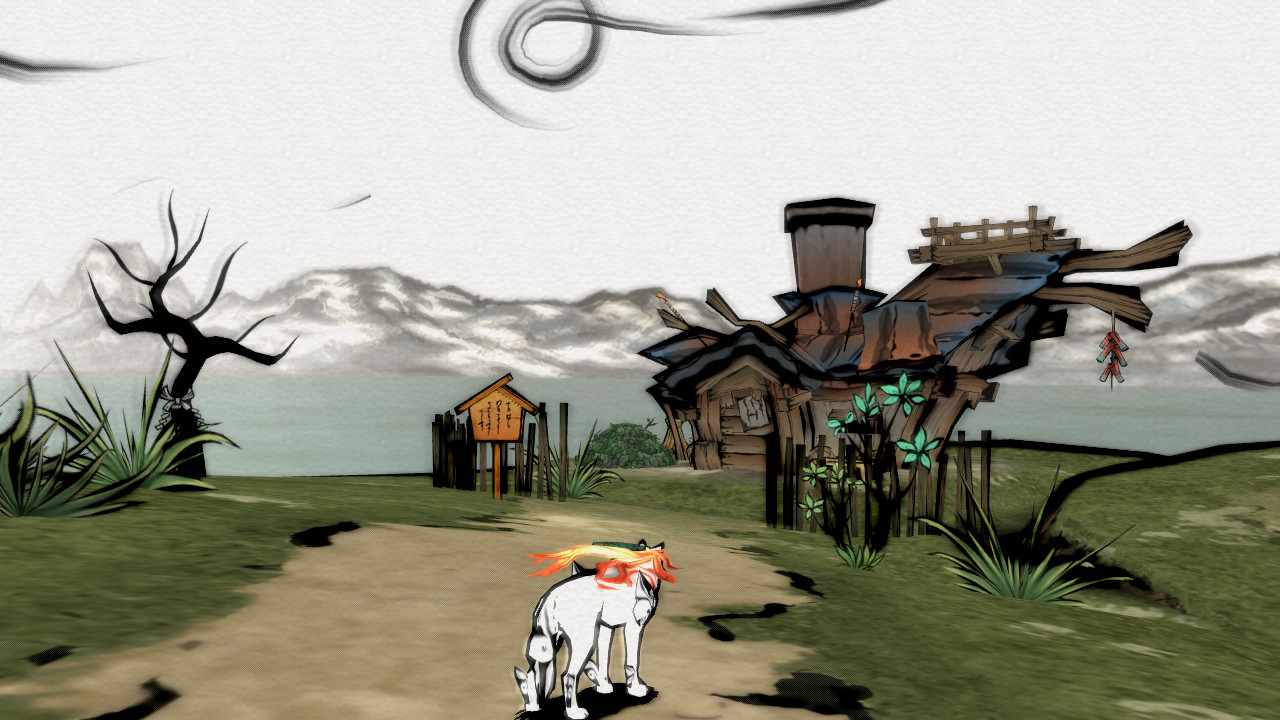
What stands out about Okami immediately are its visuals that use an ancient Japanese watercolor art style called sumi-e or ukiyo-e. Even today it stands out, but in 2006 when it originally released, it was a revelation. No game looked like that. The closest thing to it was possibly The Legend of Zelda: The Wind Waker, but that doesn’t do it justice. It gives the world of this mythological Nippon a wonderful ancient Japanese watercolor-and-paper feel. Even though they’re basically PlayStation 2 visuals, they still look great.
Also, the soundtrack is superb, which primarily uses traditional Eastern sounds and instrumentation to create something truly unique and memorable. It adds immensely to the overall atmosphere and mood of the whole experience and I never once tired of listening to any of the pieces in the game. It’s an absolute 10/10 effort from the music team that included Masami Ueda, Hiroshi Yamaguchi, Rei Kondoh, Akari Groves, and JUN.
Okami borrows a lot of its gameplay structure from The Legend of Zelda series, but its characters, story, and visual style are so unique that it doesn’t feel like you’re playing a Zelda game. While the Zelda games are all about exploration, combat, and puzzle-solving, Okami doesn’t have much in the way of puzzles, and emphasizes story instead. Meanwhile, the combat and exploration are handled in a way that is its own. So it can be said that while Okami does borrow from the Zelda series, it only does so on a basic level.
For example, the combat, which is very different than Zelda’s: when Amaterasu squares off against enemies, invisible barriers rise out of the ground enclosing her and her foes inside a small arena. Ammy can strike out with basic attacks, but also can use special abilities with her Celestial Brush.
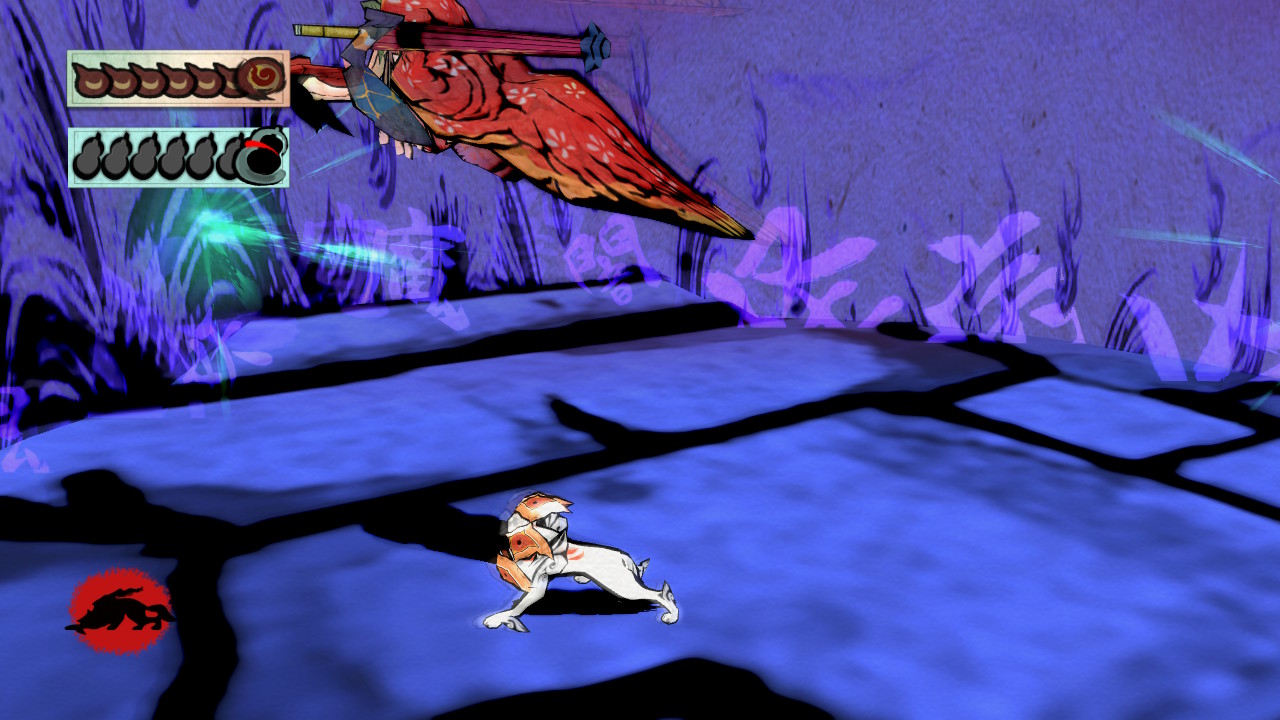
Amaterasu’s special goddess-like abilities center around her Celestial Brush. They make her more powerful in combat and give her the ability to interact with the world in a way that only a deity could do. Combined with various weapons and shields she also obtains, plus other special items, she becomes very formidable, and the battle sequences never become too difficult as long as you know how to use her different goddess-powers in the right situation. Different enemies have different weaknesses that Ammy can take advantage of. There’s even a handy bestiary that catalogs all the enemies she encounters and what their weaknesses are. However, the Celestial Brush only works if Ammy has available ink pots to use. Every brush stroke uses a certain amount of ink, and if she runs out, she has to wait for them to refill.
Once you understand how the combat and game systems work, Okami is not a difficult game. In fact, I rarely died. The combat, while fun, is somewhat on the button-mashy side. You can win most battles just pushing the Y-button, but the game pretty much tells you that during Ammy’s sensei training when she buys new moves.
The Switch version really emphasizes the interactivity of the gameplay when you use the Celestial Brush using the system’s touch screen. It feels great and I would venture to say it makes the Switch version the definitive Okami experience for that reason. You can use the control stick as well, but there’s a definite tactile difference when you put your finger on the screen to make things happen. It’s a heightened level of interactivity and it feels great.
Amaterasu gets stronger by acquiring new Celestial Brush abilities, but also by acquiring praise. She can get this by restoring the land, feeding animals, or doing good deeds for the country folk who need help. The praise Ammy gets can be used to upgrade her life meter, her reserve life meter, ink pots for her Celestial Brush, or how much money she can carry. The exploration rewards you with treasure chests Ammy can dig up containing collectibles that you can sell, or a clover she can bloom for extra praise.
The Celestial Brush mechanics work well for most of the game. However, there are times where the game demands precision with the brush that it isn’t always capable of delivering. There’s a mini-game with a character called Blockhead that comes to mind that requires repeated attempts even when you get it basically correct – and of course, every time you fail, the game has to re-explain what you’re doing wrong to make it even more tedious and annoying. Switching back and forth between using the touchscreen and the analog stick to control the brush can help if you’re playing it on a platform with a touchscreen. Otherwise, your only option during difficult sequences is to just keep trying and hope you get it right enough that the game will let you progress. These instances are not the norm however. Usually, the Celestial Brush works like it’s supposed to, but when it doesn’t, it can be very frustrating.

However, Okami’s two biggest failings are its pacing and its camera.
The pacing issues tie into how often the gameplay is being interrupted with not only lots of dialog and reading, but smaller interruptions as well, such as the small cutscene that triggers every time it changes from daytime to nighttime or vice-versa. It’s not necessary to show the player the sun is going down or coming up every time it happens. You can have some sort of audio cue to let them know, such as a change in music. That small cutscene interrupting over and over again adds up when it’s repeated over the course of a game that is dozens of hours long, especially when you add it to how often you’re being interrupted with Issun going on about something or other. Apparently, none of the Okami development team ever played Castlevania II on NES. That game is notorious for constantly interrupting the player with its day and night cycle changes.
As for the dialog, Okami is a chatty game, and Issun, Amaterasu’s companion, is probably the most talkative character I’ve run across in any video game ever. He’s constantly yammering and always has a comment to make about everything. In fact, he’s a bit of a trash-talker, and kind of annoying at times, intentionally so I suspect. If people thought Navi from Zelda: Ocarina of Time was annoying with her ‘Listen!’ interruptions, they’re definitely not going to like Issun. Not only does he talk a lot, but he gives very strong hints whenever Ammy comes across any puzzle to the point that he almost solves it for her. If you fail the puzzle, sometimes he’ll give her the instructions all over again. He’ll do that every time you fail, and it can get exhausting.
That being said, I never disliked Issun. He’s got loads of personality and humor and his positives outweigh any negatives. I hope he’s brought back for Okami 2. However, if you don’t like a lot of reading in your games, Okami’s story might not agree with you because there’s a lot of it.
Meanwhile the camera absolutely feels like it’s from 2006. Camera mechanics in games then weren’t nearly as good as they are now, and more than any other area, this is where Okami shows its age. When you try to move the camera, it’s slow and feels like it’s stuck in molasses even when it’s working properly. When it’s not, it’s clunky and can hinder gameplay and become frustrating, especially in combat.

VERDICT
Today, I don’t think there’s many that will argue that Okami was not the best game of 2006. It went from being an underground sleeper Game of the Year candidate that no one knew about, until years later in 2024, the announcement of Okami 2 at The Game Awards was arguably the biggest announcement of the show, with some fans breaking down in tears at the news – much the same way some Zelda fans got emotional when Zelda: Twilight Princess was announced at E3 2004. In fact, one could make a strong argument that Okami was so good when it released in 2006 that it took Nintendo over ten years to make another Zelda game that was comparable to it when Zelda: Breath of the Wild launched in 2017.
If you’re a Legend of Zelda fan and haven’t played Okami, you’re doing yourself a disservice. It’s a game that every Zelda fan should invest some serious time into. It takes Zelda’s basic game structure and wraps it in a package that is completely unique and adds its own ideas and mechanics to create an experience that you won’t forget. For anyone who enjoys third-person action-adventure games, Zelda or otherwise, it should be considered essential.
 The Gamer's Standard