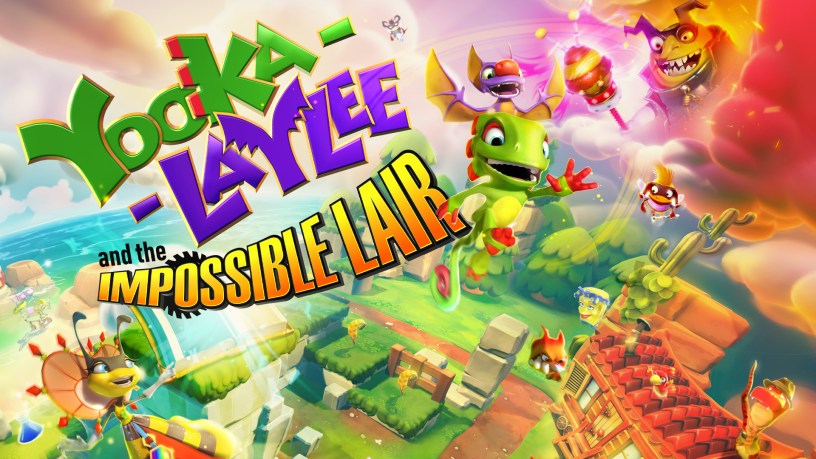
The first Yooka-Laylee released in 2017 to a good amount of anticipation. The developer was the newly-formed Playtonic Games, who were ex-Rare developers responsible for some of the most beloved titles released for Super Nintendo and Nintendo 64 in the 1990s. If you loved mascot platformers from that era, it was impossible to not being excited for Yooka-Laylee. However, the end result was somewhat divisive and disappointing for many, as the game had issues with pacing, level design, and overall mechanics.
So instead of rushing right back into another big 3D platformer, Playtonic decided to scale things down and get back to their 2D platformer roots. The result is Yooka-Laylee and the Impossible Lair, a massive improvement over the first game and one of the most enjoyable 2D platformers in years.
The basic gameplay loop is that Capital B. is up to no good once again, and Yooka and Laylee must navigate his very difficult Impossible Lair platforming stage to defeat him. In order to make the hazards more manageable, Yooka and Laylee can recruit members of Queen Phoebee’s Bee Army, but they need to be rescued from Capital B. in the game’s various stages. Every rescued bee can help our heroes in the Impossible Lair by shielding them from damage. The more bees that are collected, the more damage Yooka and Laylee can take in the final stage.

The overworld is fully explorable. There’s not a lot of platforming, but running around and solving puzzles is almost its own separate game. You move Yooka from a 2.5D perspective where you can talk to NPCs, attain tonics, and solve puzzles, and doing so is pretty close to being as fun as the actual platforming stages.
As for the stages themselves, Playtonic doesn’t try to reinvent the wheel with level design. It follows the Donkey Kong Country template with callbacks to that series. Each stage has five T.W.I.T. coins to collect that you’ll need to advance to new areas of the overworld (similar to the KONG letters), with blast cannons/barrels, ropes to swing on, and collectibles. Instead of bananas, you’re collecting golden feathers. Unlike Donkey Kong Country, a series known for its difficulty, Impossible Lair’s stages are not that hard even when you’re trying to get all the T.W.I.T. coins. If you can get through games like Donkey Kong Country: Tropical Freeze or Super Meat Boy, Impossible Lair won’t be a problem.
However, the Impossible Lair stage at the end is a different story and will test even the most experienced platformer veterans. I won’t give away much more than that, but it’s a good idea to rescue as many members of the Bee Army as you can because you’ll likely need them, at least your first time through.
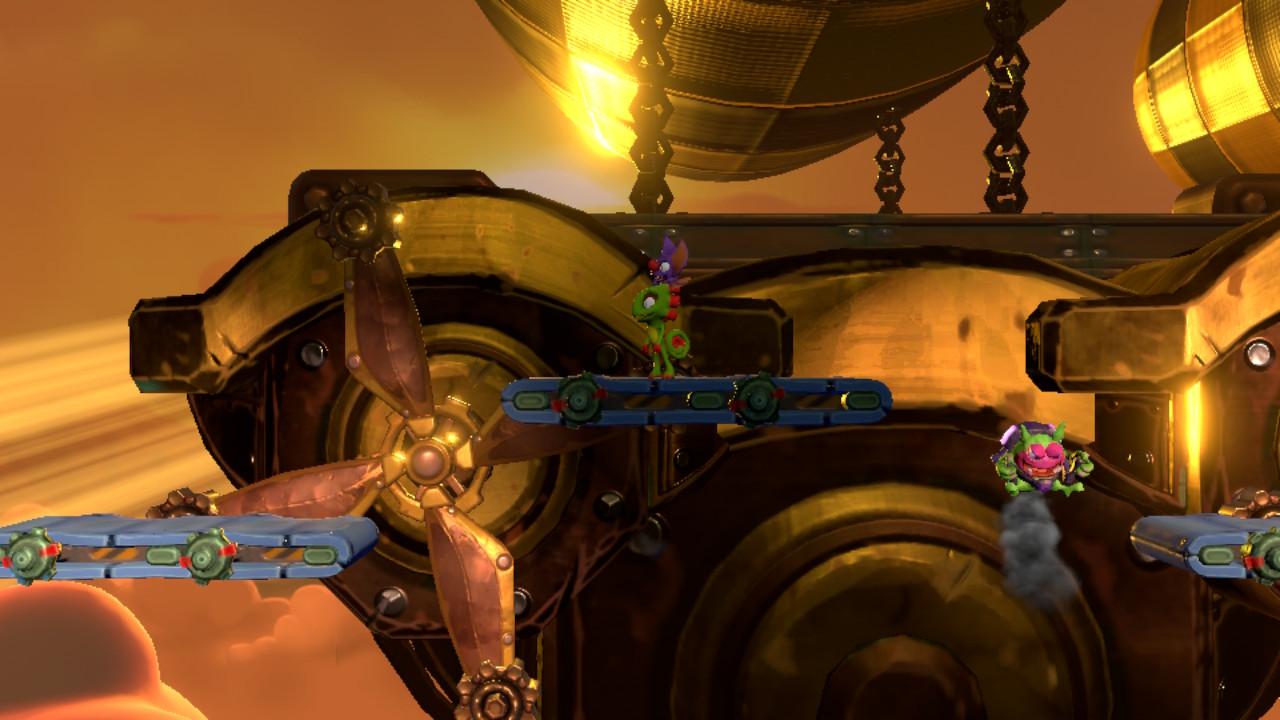
Finding and equipping tonics plays a role, much as it did in the first game, and like the first game, many of the tonics are somewhat disappointing in what they do. There’s an emphasis from the game in attaining them like they’re all important, and some of them are, but many of them don’t actually help you. They’ll change the look of the game, such as making it look like you’re playing on a CRT television, or putting the game in 4:3 aspect ratio to make it look retro, or making it look like a Game Boy game, etc, which can be fun to mess around with. Equipping the tonics that do help you will usually incur a golden feather penalty at the end as well. Meaning, depending on what tonics you have equipped, a certain percentage of your feathers will be taken away after you’ve completed the stage as a trade-off.
After you collect the tonics, you then can spend the golden feathers you’ve collected to unlock them. It’s a lot of effort for items that don’t directly impact the game, but for the ones that do, it can be worth it to have the right tonic equipped to help you through some of the tougher spots in the various stages. However, it would’ve been nice if Yooka and Laylee had a few more basic moves at their disposal from the beginning as well. Yooka has a handy ground-roll that’s effective for taking out enemies, a mid-air spin for floating, and a butt-stomp. However, if they take any damage, Laylee panics and starts flying around. If Yooka doesn’t catch her, she flies away. At that point, all Yooka can do by himself is roll and jump. He can’t do the mid-air spin or butt-stomp without Laylee.
Speaking of Laylee, this is supposed to be a buddy-platformer, yet you have one of the main characters constantly panicking and flying away whenever there’s trouble, leaving Yooka to fend for himself. They’re supposed to be a team! Laylee is basically just a power-up for Yooka, similar to Mario getting a power mushroom to become Super Mario. I can’t imagine Kazooie running off and leaving Banjo to fend for himself just because they took a a little damage from a hazard or an enemy. Grr…

The original Yooka-Laylee had slippery controls, and unfortunately, that tradition continues with Impossible Lair. Rolling with Yooka feels out of control at times, and when he comes out of his roll and you need to change direction right away, he takes a big slide before doing so. The controls are not bad by any stretch, especially given that it’s not an overly difficult game, but they’re not tight either, and I found myself wishing they were at times playing through the stages.
However, there’s a massive improvement with the load times on Switch, which was a constant issue and ruined the pacing of the first game. In Impossible Lair, there’s one long load time getting into the overworld, but after that, it’s smooth sailing. Getting in and out of levels was a snap, plus there’s a handy option in the menu to restart a stage whenever you need to. When you choose it, you’re quickly back at the beginning with almost no wait time. Great job.
The music is outstanding and combines the efforts of David Wise, Grant Kirkhope, Matt Griffin, and Dan Murdoch. David Wise is famous for his work on the Donkey Kong Country series, and Grant Kirkhope for his work on the Banjo-Kazooie games. It’s another stellar effort with the soundtrack.
Visually, the game looks great and runs at a very solid 60 FPS on Switch. The overworld is colorful, green, and lush and Playtonic flexes their visual muscles with some of the lighting on metal objects in the various stages. It runs well on Switch, and so I assume the same is true on the more powerful platforms the game is on as well.
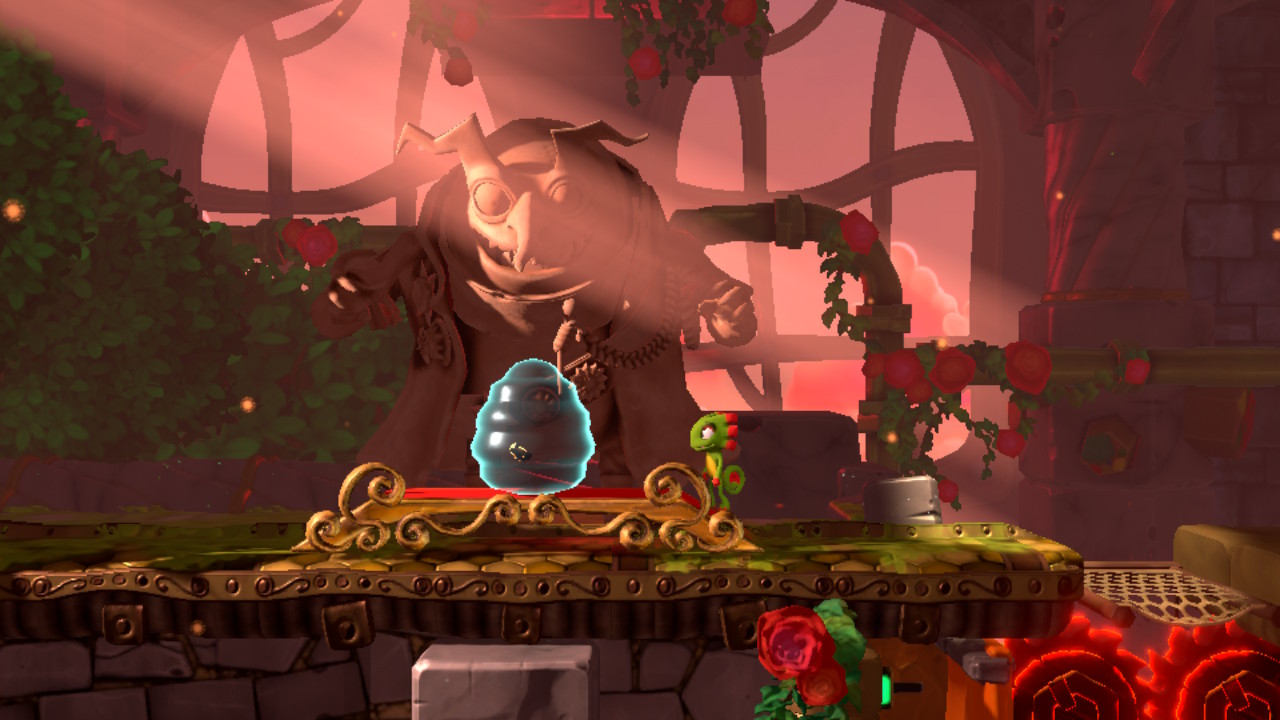
All the comedic writing and humor makes its return in Impossible Lair. If you liked it in the original Yooka-Laylee, you’ll like it here as well. Most of it occurs in the overworld where Yooka and Laylee are interacting with NPCs and solving puzzles, but it’s the same type of googly-eyed characters you’d expect from this team, and I enjoyed it quite a bit.
VERDICT
Playtonic has hit their stride with Impossible Lair, and it’s what I wanted the original Yooka-Laylee to be. The overworld is a joy to roam around in with the characters and writing, and the stages are well-designed, look great, and are set to the backdrop of some fantastic tunes from the music team. Hopefully, Playtonic’s future efforts with their chameleon and bat team will only get better. If you like 2D platformers, especially Donkey Kong Country, Yooka Laylee and the Impossible Lair is likely to please.
 The Gamer's Standard